
If you have ever heard people talk about an archery lottery in the hills of Northeast India and wondered what is Shillong Teer, this guide is for you. Shillong Teer is a legal lottery game played in Shillong, the capital city of Meghalaya, where the winning number is decided not by spinning balls or drawing paper slips but by real archers shooting real arrows at a target. Every working day, crowds gather at the Polo Ground in Shillong to watch skilled archers loose hundreds of arrows, and the count of arrows that strike the target decides a two digit number between 00 and 99. Players place their wagers on the number they believe will appear, and those who match the declared result win prizes.
What makes this teer game so fascinating is that it did not begin as a lottery at all. It began as a sport. Archery has been part of Khasi life in the hills of Meghalaya for centuries, long before anyone thought of betting on it. Over generations, friendly wagers between spectators grew into an informal betting culture, and eventually the state government brought the whole practice under legal regulation. Today Shillong Teer stands as one of the most unusual legal lotteries in the world, a game where tribal heritage and modern gaming rules exist side by side.
In this beginner friendly guide from All Teer Results, we will walk you through the complete story: the ancient Khasi archery tradition, the colorful shillong teer history that turned a tribal sport into an organized teer lottery, exactly how teer works round by round, how to read a result, and the rules that keep the game fair and responsible.

What Is Shillong Teer – A Simple Definition
At its simplest, Shillong Teer is an archery based lottery conducted in Shillong, Meghalaya. The word “teer” itself means “arrow” in Hindi, which tells you everything about the heart of the game. General background on the game is also summarized on Wikipedia’s Teer page. Unlike most lotteries where numbers are drawn at random by machines, here the number is produced by human skill and physics: a group of archers shoots arrows at a cylindrical bamboo target, officials count how many arrows hit the target, and the last two digits of that count become the winning number for the round.
Let us break that down with a simple illustration. Suppose the archers shoot a large volley of arrows and the officials count the ones that struck the target. If the final count ends in the digits shown as “-” (placeholder, not a real result), those digits would form that round’s result. The actual count of arrows is always much larger; only the last two digits matter. That two digit number, ranging from 00 to 99, is what players bet on.
The game is played in two rounds every day, commonly called the First Round (FR) and the Second Round (SR). Tickets for each round are sold at licensed counters before the round begins, and each round has its own separate result. The First Round takes place in the mid afternoon and the Second Round follows later in the afternoon. Because the archers must shoot, the arrows must be counted carefully, and the tally must be verified, each round is a genuine live event that people attend in person at the ground.
It is important to understand that Shillong Teer is a game of chance built on top of a game of skill. The archers are genuinely skilled, and their accuracy determines the total count, but no player and no archer can control the exact last two digits of that count. That unpredictability is what makes it a lottery. The teer lottery is legal in Meghalaya under state regulation, and it is meant for adults aged 18 and above who choose to participate responsibly.
The Deep Roots – Archery in Khasi Culture
To truly understand what is Shillong Teer, you have to look beyond the betting counters and into the hills themselves. The Khasi people, the indigenous community of the Khasi Hills region of Meghalaya, have practiced archery for centuries. Long before Shillong became a bustling hill station and the capital of the state, archery was woven into everyday Khasi life.
Archery as a Way of Life in the Khasi Hills
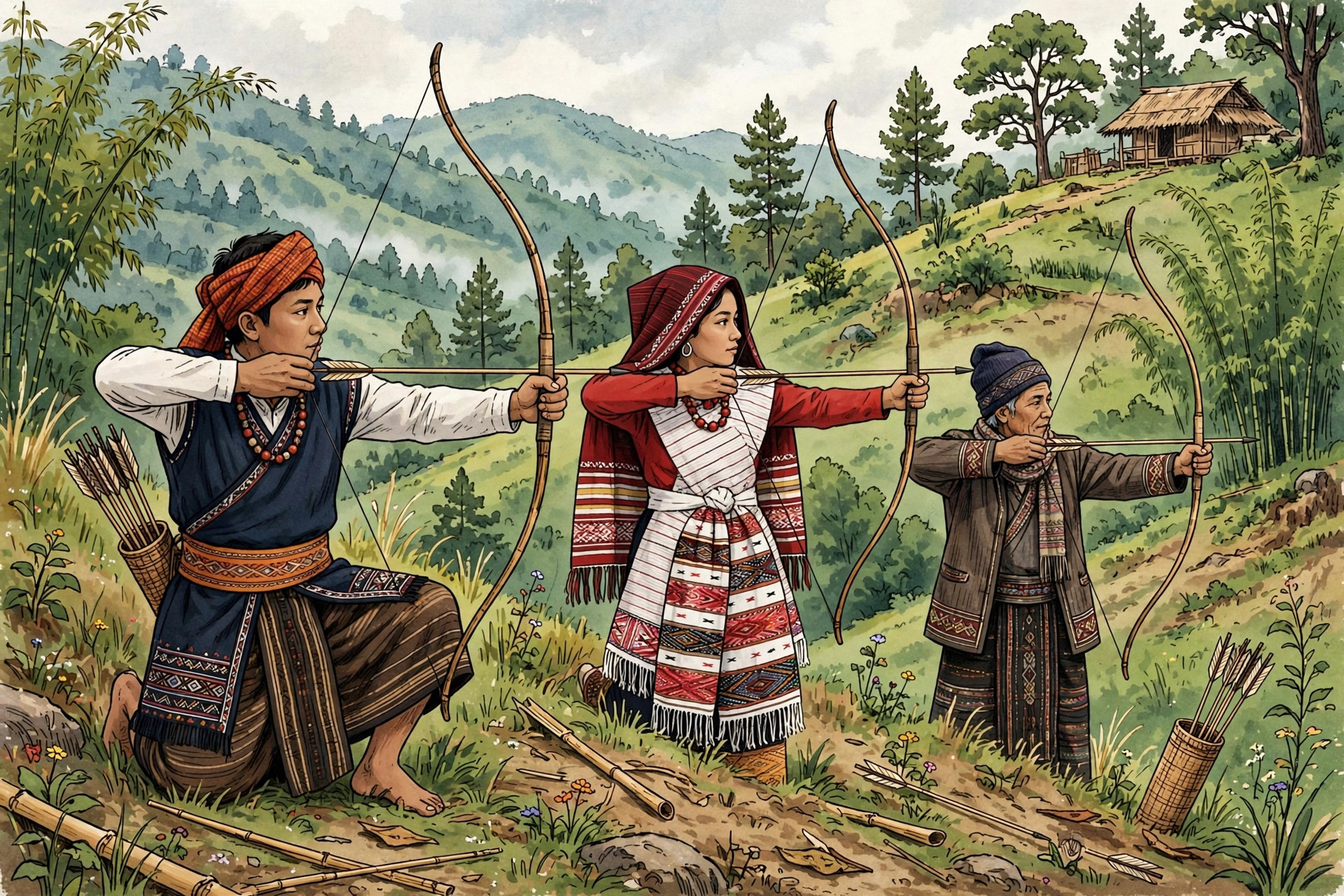
In traditional Khasi society, the bow and arrow were tools of survival before they were instruments of sport. Young men learned to shoot to protect crops and livestock, and marksmanship was a respected skill that carried genuine social prestige. But the Khasi people also turned archery into celebration. Village festivals, seasonal gatherings, and community events regularly featured archery contests where the finest shooters of the region competed for honor and modest prizes.
These contests were social occasions in every sense. Families would pack food and spend the day on the shooting ground. Elders would discuss the form of each archer the way cricket fans today discuss a batsman’s technique. Children would watch wide eyed and dream of the day they might draw a bow themselves. The traditional Khasi bow, crafted from bamboo with bamboo arrows, was simple in construction but demanded real mastery to use well. Archery as a global discipline shares the same fundamentals of stance, draw, and release that Khasi archers have practiced for generations. Hitting a distant target consistently with such equipment requires years of practice, steady nerves, and an intimate understanding of wind and distance.
This deep cultural bond between the Khasi people and archery is the essential background of shillong teer history. The game could only have been born in a place where archery was already a beloved public spectacle, because the entire lottery depends on having both skilled archers and an audience that loves watching them shoot.
From Village Contests to Public Spectacle
As Shillong grew through the twentieth century, first as an important hill station and later as the capital of Meghalaya after the state was formed in 1972, archery contests moved from scattered village grounds to larger organized venues. The Polo Ground in Shillong became the most famous of these venues, a large open field where major archery events could draw substantial crowds.
With bigger crowds came a new element: spectators began placing friendly wagers among themselves on the outcomes. At first these were casual bets between friends and neighbors, a way to add excitement to an afternoon of sport. Who would shoot the straightest? How many arrows would strike the target in a given session? These informal questions, debated over tea at the edge of the ground, planted the seeds of what would eventually become the teer game. Nobody at the time was designing a lottery. They were simply enjoying a sport they loved, with a little friendly staking on the side to sharpen the thrill.
Shillong Teer History – From Tradition to Organized Game
The journey from village archery contests to the modern organized lottery happened gradually over decades. Understanding this shillong teer history helps explain why the game looks the way it does today, with its two daily rounds, its licensed ticket counters, and its official result declarations.
The Informal Betting Era
Through the middle of the twentieth century, wagering on archery results in and around Shillong grew from casual friendly bets into a widespread informal practice. Local organizers began arranging the betting more systematically. Certain grounds developed regular schedules, familiar archers built reputations, and networks of ticket sellers emerged to take wagers from the public. By the 1970s, what had started as a pastime had become a significant underground economy in the Khasi Hills.
This informal era had obvious problems. Without regulation, there were disputes about results, concerns about fairness, and no protection for either players or organizers. The game was popular, but it operated in a grey zone. The state government of Meghalaya faced a choice that many governments face with deeply rooted popular games: try to suppress it entirely, or bring it into the open with rules and oversight. Meghalaya chose the second path.
Legalization and State Regulation
In the early 1980s, the government of Meghalaya moved to legalize and regulate archery based betting through the framework of the state’s amusement and betting tax laws. This was a landmark moment in shillong teer history. Teer became one of the few forms of gambling to be explicitly legalized by an Indian state government, placed under official supervision with licensed organizers, authorized ticket counters, and a tax structure that directed revenue to the state.
Legalization changed the character of the game. Organizers now operated openly. Results were declared through official channels, which reduced disputes. Ticket sellers worked under licenses. The game gained a formal structure with defined rounds, fixed schedules, and accountable record keeping. What had been an informal hillside pastime became the meghalaya teer that players know today: a state regulated teer lottery with transparent procedures.
The decision also reflected something deeper about Meghalaya’s identity. Rather than treating the archery betting tradition as a problem to be erased, the state recognized it as a cultural practice that could be preserved and managed. The legal framework protected the heritage aspect of the game while imposing the order that any public lottery needs.
The Modern Era at Polo Ground
In the decades since legalization, Shillong Teer has settled into the rhythm that regular players recognize. The game is conducted at the Polo Ground in Shillong under the supervision of the Khasi Hills archery bodies, with state oversight of the betting operations. Every working day except Sundays and certain holidays, the two rounds take place in the afternoon, drawing players, spectators, and tourists who come to witness this unique blend of sport and lottery.
The modern era has also brought the game to a wider audience. Where once you had to be physically present in Shillong to participate or even to learn the result, today the results travel far beyond the hills. Websites and result portals publish the declared numbers each day, allowing the large community of teer enthusiasts across the Northeast and beyond to follow the game. If you want to follow the daily declarations, you can check the latest numbers on our dedicated Shillong Teer result page, which is updated as each round is officially announced.
Despite this wider reach, the core of the game has not changed. Real archers, real arrows, a real target, and a real count. That continuity is what keeps the tradition alive.
How Teer Works – The Two Rounds Explained
Now that you know the history, let us look at exactly how teer works on a typical playing day. The structure is straightforward once you understand the two round format.
First Round (FR)
The day’s play begins with the First Round in the mid afternoon. Licensed ticket counters stop selling FR tickets shortly before the shooting starts. Then the archers take their positions at a set distance from the target and begin shooting in a coordinated session. Each archer shoots a fixed number of arrows, and with dozens of archers participating, the total number of arrows loosed in a round runs into the hundreds.
When the shooting ends, officials carefully count every arrow that struck the target. Arrows that missed do not count. This counting is done openly and carefully because the entire result depends on it. Once the count is finalized and verified, the last two digits of the total become the First Round result. For example, if the count of hitting arrows ends with the digits shown as “-” (placeholder illustration only, not a real result), the FR result for the day is declared accordingly. The result is then announced publicly and circulated to ticket counters and result portals.
Second Round (SR)
After a break, the Second Round follows later in the afternoon with a fresh round of ticket sales beforehand. The procedure is the same: the archers shoot again, officials count the arrows that hit the target, and the last two digits of the count form the SR result. The Second Round is a completely separate event from the First Round. A new count means a new result, and tickets purchased for the FR do not carry over to the SR.
Players who enjoy the game often participate in both rounds, but each round stands alone. This two round structure effectively gives players two separate lottery events every playing day, which is part of why the game sustains such a large and engaged following.
How the Winning Number Is Decided
The mechanism deserves a clear summary because it is the most distinctive thing about this teer lottery:
- Archers shoot a large number of arrows at the bamboo target during the round.
- Officials count only the arrows that actually struck the target.
- The last two digits of that count become the winning number (00 to 99).
- Players whose ticket number matches the declared number win prizes as per the payout structure.
No random number generator is involved. No machine picks the digits. The number emerges from the physical reality of the shooting session, which is why the game can honestly be called an archery lottery rather than a conventional draw.

How to Read a Shillong Teer Result
For a newcomer, a teer result listing can look cryptic at first. In practice it is very simple.
Understanding the Two Digit Format
Every Shillong Teer result is a two digit number from 00 to 99. Results are always presented per round, so on a normal playing day you will see two numbers: one for the First Round and one for the Second Round. A typical daily listing shows the date, the FR result, and the SR result. That is the entire format. There are no bonus numbers, no additional draws, and no complicated combinations to decode.
When you look at a result, you are looking at the last two digits of the arrow count from that round’s shooting session, as explained above. If you hold a ticket for a round, you simply compare your ticket’s number with the declared result for that same round. A match means a win according to the payout terms of the counter where you purchased the ticket.
Where to Check Daily Results
Results are declared at the ground and then spread through official and media channels. Many players check result portals online because they publish the numbers quickly after each declaration. Our full teer result list brings together the daily FR and SR results in one place so you can verify the numbers for any playing day. When checking results anywhere online, remember the golden rule of this game: only trust the declared result, never a predicted one. The result comes from the arrows, and anything claiming to know it in advance is not legitimate.
Teer Lottery Rules and Responsible Play
Because Shillong Teer is a legal lottery, it operates within rules that every player should know.
Legal Status in Meghalaya
The teer lottery is legal in the state of Meghalaya, where it is regulated by the state government. Licensed organizers conduct the game, licensed counters sell the tickets, and the state collects tax revenue from the operations. This legal status applies within Meghalaya. Players should be aware that gambling laws differ across Indian states, and what is legal in Meghalaya may not be legal elsewhere. The game is intended for adults: participants must be 18 years of age or older.
Age and Responsibility Guidelines
Like any form of lottery or betting, teer should be treated as entertainment, not as a way to earn a living. Set a strict budget before you play and never wager money you cannot afford to lose. Never chase losses by increasing your stakes, and take breaks if the game stops being fun. If you or someone you know shows signs of problem gambling, seek help from a professional support service. The responsible play message is simple: teer is a legal lottery in Meghalaya, for adults 18+ only, play responsibly.

Shillong Teer in Meghalaya Culture Today
It is worth stepping back to appreciate what the game means to the region today. Shillong Teer is more than a lottery to the people of the Khasi Hills. It is a daily event that brings the community together at the Polo Ground, a living link to the archery heritage of their ancestors, and a source of livelihood for archers, organizers, ticket sellers, and many others whose work revolves around the game.
Tourists visiting Shillong are often surprised to discover that they can watch a traditional archery contest that doubles as a legal lottery. For many visitors, attending a teer session becomes a highlight of their trip, a chance to see Khasi culture in action rather than in a museum. The archers themselves are respected figures, athletes who have mastered one of the most difficult traditional disciplines, the bamboo bow.
The game has also become part of the broader identity of Meghalaya, the “abode of the clouds.” Just as the living root bridges and the monsoon landscapes define the state for outsiders, teer defines it for those interested in its living traditions. It is a reminder that lotteries do not have to be sterile computer draws. They can grow out of the soil of a place, shaped by its history and carried forward by its people.
Frequently Asked Questions About What Is Shillong Teer
What is Shillong Teer in simple words?
Shillong Teer is an archery based lottery played in Shillong, Meghalaya. Archers shoot arrows at a target, officials count the arrows that hit, and the last two digits of the count become the winning number of the round. Players bet on a two digit number from 00 to 99 before each round, and matching the declared result wins a prize. The game is legal in Meghalaya and regulated by the state government.
How old is the Shillong Teer game?
The archery tradition behind the game is centuries old, rooted in Khasi culture of the Khasi Hills. Betting on archery contests grew informally through the twentieth century, and the game was brought under legal state regulation in the early 1980s. So while the sport is ancient, the organized teer lottery as players know it today has existed in its legal form for several decades.
How many rounds are played each day?
Two rounds are played on each working day: the First Round (FR) in the mid afternoon and the Second Round (SR) later in the afternoon. Each round has its own ticket sales, its own shooting session, its own arrow count, and its own declared result. The game is generally not held on Sundays and certain public holidays.
How is the winning number actually decided?
The winning number is decided by counting. After the archers finish shooting in a round, officials count every arrow that struck the target. The last two digits of that total count form the result, which is always a number between 00 and 99. Because the count depends on the physical shooting, the result cannot be known before the round is completed and counted.
Is Shillong Teer legal?
Yes, Shillong Teer is a legal lottery in the state of Meghalaya, where it operates under state regulation with licensed organizers and ticket counters. It is open to adults aged 18 and above. Gambling laws vary by state in India, so players should always check the rules that apply in their own location and participate only where it is lawful to do so.
Where can I check the daily Shillong Teer result?
Results are declared at the Polo Ground in Shillong after each round and are then published through official channels and result portals. You can follow the daily FR and SR numbers on the All Teer Results homepage, where the declared results are published each playing day along with archives of previous days.

Conclusion
What is Shillong Teer? It is a lottery, yes, but it is also a story: the story of Khasi archers who turned a survival skill into a celebrated sport, of hillside contests that grew into a beloved public spectacle, and of a state that chose to preserve a tradition by regulating it. Every afternoon at the Polo Ground, that story continues one arrow at a time. If you are new to the game, start by understanding its heritage and its rules, check results only from declared sources, and remember that teer is entertainment for adults to be enjoyed responsibly. To learn more about who we are, visit our about page.