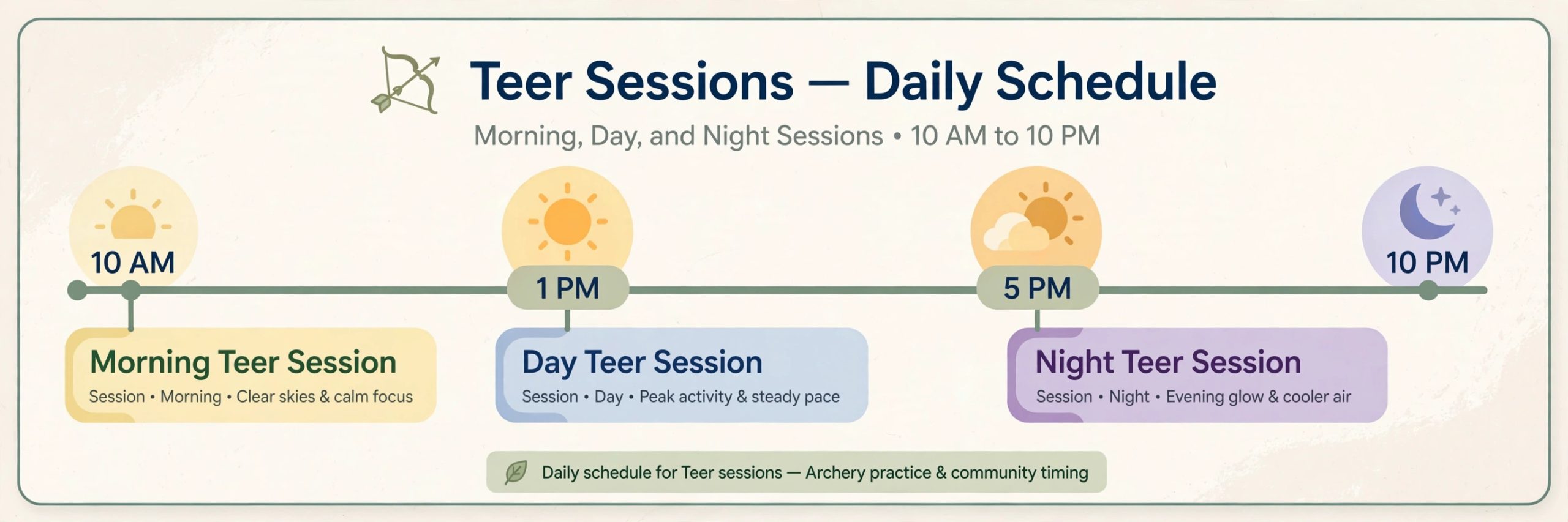
If you have ever opened a teer result website and felt confused by the number of sessions on the page, you are not alone. The words morning teer vs day teer appear on almost every result portal, and new visitors often ask what the difference actually is. This guide answers that question in full. Morning teer and day teer are two separate daily sessions of the same archery based lottery game played in Meghalaya. They share the same rules and the same result format, but they run at different hours, cover different markets, and are declared as independent results. Understanding the timetable is the key to reading any result page correctly, so this article walks through the complete schedule session by session and then places morning teer vs day teer side by side for easy comparison.
What Morning Teer vs Day Teer Means
The phrase morning teer vs day teer is simply a comparison between the two main daytime sessions of the teer game. Teer is a legal lottery game in the state of Meghalaya in India, where the result is decided by the number of arrows that hit a target during archery rounds. The game is organised every working day in several sessions. The morning session, as the name suggests, takes place in the late morning hours. The day session, sometimes called the afternoon session, takes place after midday.
Each session is fully independent. That means the morning session has its own first round and second round, and the day session has its own first round and second round. A result declared in the morning session has no connection to the result declared in the day session. They are decided by different rounds of archery, held at different venues or shooting grounds, and recorded as separate results. When a result website shows nine cards on its homepage, several of those cards belong to the morning group and several belong to the day group, which is why learning the difference matters.
The comparison of morning teer vs day teer becomes important the moment you try to check a result. If you look for the Shillong result at 11 in the morning, you will find the Shillong Morning Teer result, not the main Shillong Teer result that most people talk about. The main Shillong Teer result arrives in the afternoon as part of the day session. Mixing the two up is the most common mistake new visitors make, and this guide is designed to make sure you never make it.
Morning Teer Sessions and Their Timings
The morning teer group covers three markets. Each one runs two rounds, called the first round (FR) and the second round (SR), and each round produces a two digit number based on the arrows shot. Here is how the morning timetable usually looks.
Shillong Morning Teer timing
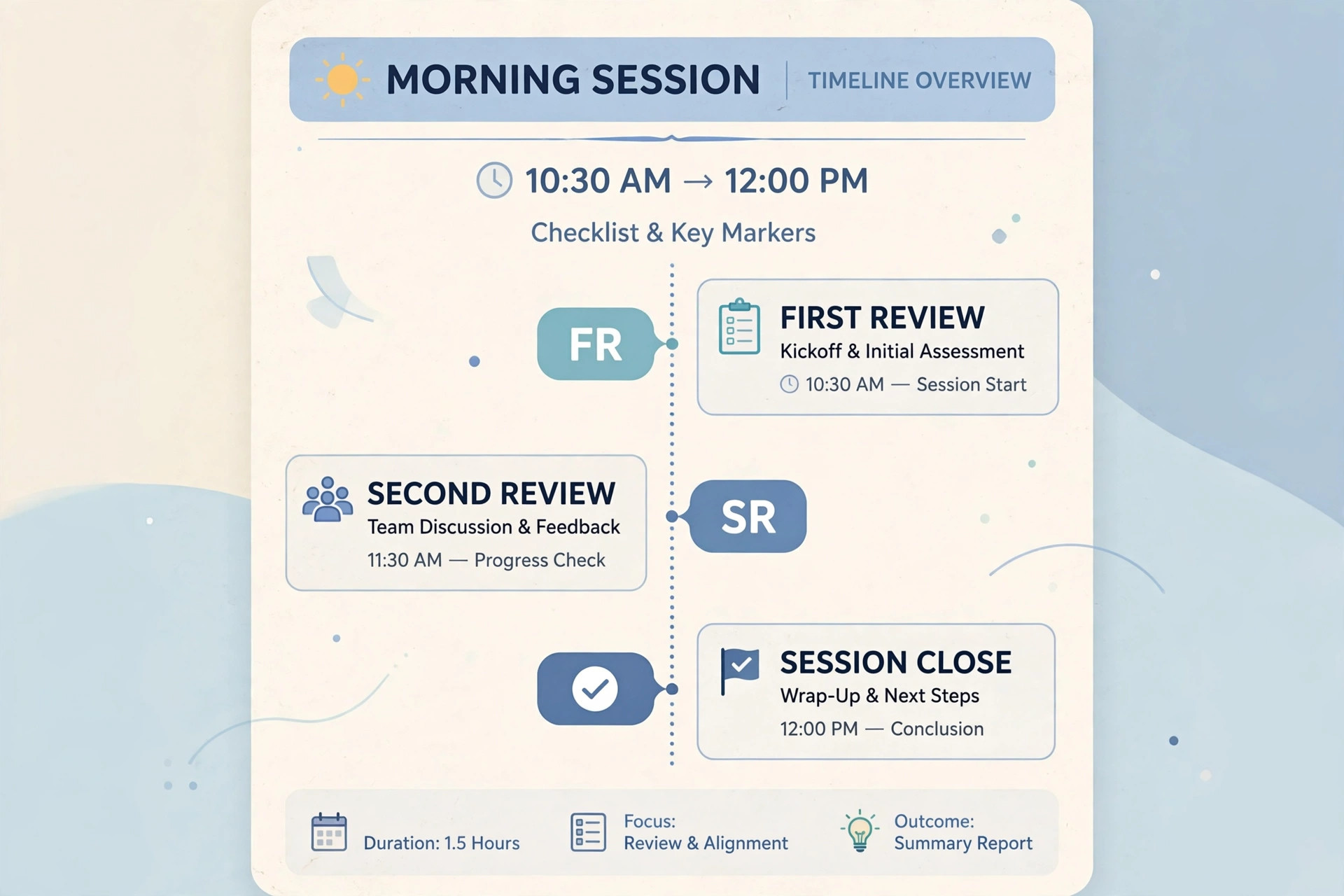
Shillong Morning Teer is the morning version of the Shillong game. Its first round is usually declared around 10:30 AM and its second round around 11:30 AM. These times are given in Indian Standard Time, which is the timezone used by the organising clubs in Meghalaya. Because the rounds happen one after the other, the full morning result for Shillong is normally complete before noon. If you check a result portal at lunchtime, the Shillong Morning Teer card should already show both the FR and the SR numbers for that day.
Juwai Morning Teer timing
Juwai Morning Teer follows almost the same pattern. The first round is generally declared around 10:30 AM and the second round around 11:30 AM. Juwai is a town in the West Jaintia Hills district, and its morning session mirrors the Shillong morning session in structure. The two markets are separate though. The archery rounds are held separately, the numbers are decided separately, and the results are recorded separately. You can follow both on the same result page, but you should read them as two independent results.
Khanapara Morning Teer timing
Khanapara Morning Teer runs slightly later than the other two morning markets. Its first round is usually declared around 11:00 AM and its second round around 12:00 PM. Khanapara is the teer centre associated with the Assam Meghalaya border area near Guwahati, and its morning session gives late risers a second chance to catch a morning result. By early afternoon, all three morning sessions are normally finished, and attention shifts to the day session.
One practical point about the morning group: the three markets do not start and end at exactly the same minute. There can be small delays on any given day because the declaration depends on the archery actually being completed and counted at each ground. Result websites update each card as soon as the official number is confirmed, so it is normal to see one morning card filled in while another still shows a dash for a few minutes.
Day Teer Sessions and Their Timings
The day teer group is the afternoon block, and it contains the most widely followed markets, including the main Shillong Teer result. Like the morning group, each day market runs a first round and a second round.
Shillong Teer (day) timing
The main Shillong Teer result is the headline result of the day for most followers. Its first round is usually declared around 3:45 PM and its second round around 4:45 PM Indian Standard Time. This is the result that the majority of teer followers wait for, and it is the one most commonly meant when someone simply says the Shillong teer result without adding morning or night. Because it arrives in the late afternoon, there is a gap of several hours between the end of the morning session and the start of the day session.
Juwai Teer (day) timing
Juwai Teer in the day session is usually the earliest of the afternoon markets. Its first round is generally declared around 2:30 PM and its second round around 3:10 PM. This makes Juwai the bridge between the morning block and the rest of the afternoon block. Followers who track Juwai often check the morning Juwai result first and then return in the early afternoon for the day Juwai result.
Khanapara Teer (day) timing
Khanapara Teer in the day session is usually declared in the late afternoon. The first round generally comes around 4:20 PM and the second round around 4:50 PM. Because Khanapara day rounds happen close together, the full result for this market is often completed within about half an hour. It is the last of the three main day markets to finish on most days, apart from the separate night sessions that run in the evening.
Just like the morning group, the day session timings are usual hours rather than guaranteed exact minutes. Archery rounds can run slightly long, counting can take extra time, and public holidays or local disruptions can shift a session. A reliable result portal will show the declaration time next to each result so you can see exactly when a number was confirmed.
Morning Teer vs Day Teer – Round by Round Comparison
Now that both timetables are laid out, here is the direct comparison of morning teer vs day teer, round by round.
The first difference is the hour of the day. Morning teer rounds are declared between roughly 10:30 AM and 12:00 PM. Day teer rounds are declared between roughly 2:30 PM and 4:50 PM. There is a clear midday gap between the two blocks, which is why they are treated as separate sessions rather than one long session.
The second difference is which markets belong to each block. The morning block contains Shillong Morning Teer, Juwai Morning Teer, and Khanapara Morning Teer. The day block contains Shillong Teer, Juwai Teer, and Khanapara Teer. Notice that the market names repeat across the two blocks. Shillong appears in both, Juwai appears in both, and Khanapara appears in both. The session label, morning or day, is what tells them apart. This is exactly why result cards always carry the full name, such as Shillong Morning Teer or Shillong Teer, and why you should always read the full card title before noting a number.
The third difference is follower attention. The day session, and especially the main Shillong Teer result, draws the largest audience. The morning session has a smaller but steady following of people who prefer to check results before midday. Neither session is more official than the other. Both are organised under the same legal framework in Meghalaya, both use the same archery based method, and both results are equally valid for the tickets sold for that session.
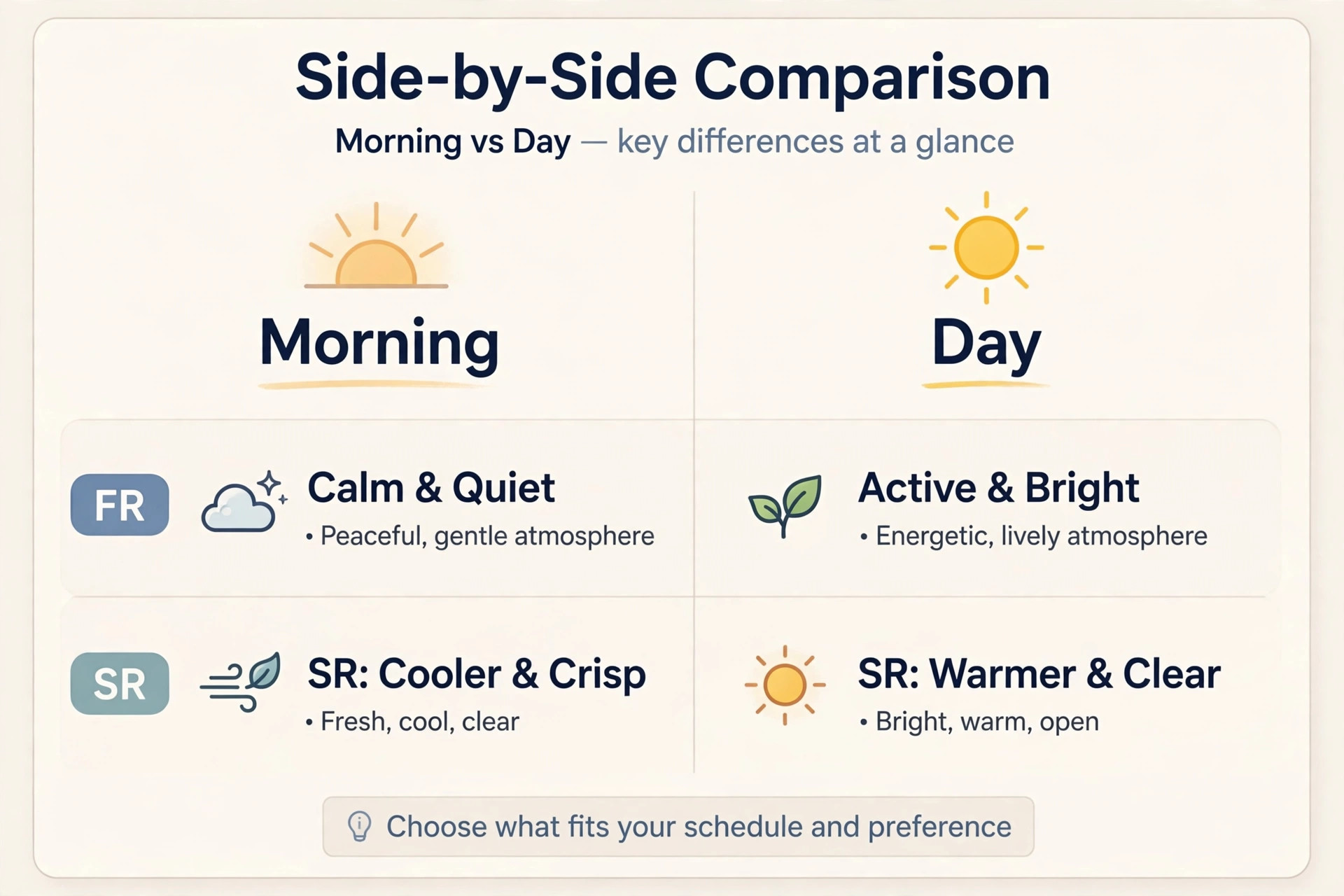
The fourth point of comparison is the result format, and here there is no difference at all. Every market in both sessions publishes a first round number and a second round number. Each number has two digits, from 00 to 99. If a round has not been declared yet, result websites show a dash instead of a number. The format is identical whether you are looking at a morning card or a day card, which makes the timetable the only thing you need to tell them apart.
How a Full Teer Day Unfolds
It helps to picture a full teer day from start to finish. Here is how the sessions usually flow on a normal working day.
The day begins with the morning block. Around 10:30 AM, the first rounds of Shillong Morning Teer and Juwai Morning Teer are declared. Around 11:00 AM, the Khanapara Morning Teer first round follows. Around 11:30 AM, the second rounds of the Shillong and Juwai morning markets are declared, and around 12:00 PM the Khanapara Morning second round completes the morning block. By early afternoon, all morning results for the day are final.
Then comes a quiet gap of about two hours. No new teer results are declared during this window on most days. This is the natural break between the morning and day sessions, and it is a good time to double check the morning numbers you noted.
The afternoon block starts with Juwai Teer around 2:30 PM for the first round and 3:10 PM for the second round. The main Shillong Teer follows with its first round around 3:45 PM and second round around 4:45 PM. Khanapara Teer closes the day block with rounds around 4:20 PM and 4:50 PM. After that, the evening belongs to the night sessions, Shillong Night Teer and Night Teer, which are separate from both the morning and day groups and are usually declared around 8:30 PM and 9:30 PM.
Seeing the whole day laid out like this makes the morning teer vs day teer distinction obvious. They are two chapters of the same daily story, separated by a midday pause.
Key Differences at a Glance
For quick reference, here is a summary table of the morning teer vs day teer comparison.
| Feature | Morning Teer | Day Teer |
|---|---|---|
| Usual hours | 10:30 AM to 12:00 PM | 2:30 PM to 4:50 PM |
| Markets | Shillong Morning, Juwai Morning, Khanapara Morning | Shillong, Juwai, Khanapara |
| Rounds per market | First round and second round | First round and second round |
| Result format | Two digit numbers, dash if pending | Two digit numbers, dash if pending |
| Main headline market | Shillong Morning Teer | Shillong Teer |
| Follower size | Smaller morning audience | Largest audience of the day |
| Legal status | Legal Meghalaya lottery, 18 plus only | Legal Meghalaya lottery, 18 plus only |
Every row of this table reinforces the same lesson. The sessions differ in timing and audience, not in rules or legitimacy.
Which Session Should You Follow
There is no rule that says you must follow one session or the other. Many regular followers check both. But your daily routine may make one session more convenient.
If your mornings are free, the morning session gives you a complete result before lunch. You can check the Shillong Morning, Juwai Morning, and Khanapara Morning cards, note the numbers, and be done for the first half of the day. If you work during the morning and only get free time in the afternoon or evening, the day session is the natural fit, with the main Shillong Teer result arriving in the late afternoon.
Some followers track only one market across both sessions. For example, a Shillong focused follower might check Shillong Morning Teer at 11:30 AM and then the main Shillong Teer at 4:45 PM. Others track one session across all markets, checking every morning card or every day card. Both approaches are fine as long as you always match the result to the correct session label.
A useful habit is to check results on a portal that shows the declaration time next to each number, like the result cards on All Teer Results. When each card shows both the date and the time, there is no room for confusion between a morning number and a day number. You can also browse the full archive on the teer result list page to see how past days were split between the sessions.

How to Check Both Sessions Without Confusion
Confusion between morning teer vs day teer almost always comes from one of three mistakes. Here is how to avoid each one.
The first mistake is reading the wrong card. Result homepages show many cards with similar names. Always read the complete card title. Shillong Morning Teer and Shillong Teer are different cards with different numbers. Slow down and match the title to the session you want before you read the numbers.
The second mistake is checking at the wrong hour. If you open a result site at 11:00 AM expecting the main Shillong Teer result, you will be disappointed because that result does not exist yet. It arrives around 3:45 PM. Learn the timetable above and check each session inside its own window. Checking too early only leads to seeing dashes and assuming something is wrong.
The third mistake is mixing dates. Because the morning session happens early, some followers accidentally compare a morning result from today with a day result from yesterday. Always confirm the date shown on the card along with the time. A good result portal displays both, and you should make it a habit to read both before noting any number.
If you follow these three habits, read the full card title, check inside the right time window, and confirm the date, you will never confuse the morning session with the day session again.
Frequently Asked Questions
What is the main difference in morning teer vs day teer?
The main difference is timing. Morning teer sessions are declared between about 10:30 AM and 12:00 PM, while day teer sessions are declared between about 2:30 PM and 4:50 PM. Both sessions use the same archery based game, the same first round and second round format, and the same two digit result numbers. They are independent sessions, so a morning result and a day result for the same market name are decided by different rounds and have no connection to each other.
Is the morning teer result official?
Yes. Morning teer is an official session of the legal teer lottery in Meghalaya, organised for adults aged 18 and above. It is not a practice round or an unofficial version. The Shillong Morning Teer, Juwai Morning Teer, and Khanapara Morning Teer results are declared by the organising clubs just like the day session results, and they are equally valid for the tickets sold for those morning rounds. For background on the state where the game is regulated, see the official Meghalaya government portal and the Meghalaya article on Wikipedia.
Which day teer result is the most popular?
The main Shillong Teer result, declared in the afternoon with rounds around 3:45 PM and 4:45 PM, is the most widely followed result of the day. When people say the Shillong teer result without specifying a session, they almost always mean this day session result. It draws a larger audience than the morning session and the night sessions.
Can I check morning and day results on the same website?
Yes. Most teer result portals show all sessions on one homepage, with separate cards for each market and session. The homepage of All Teer Results displays morning, day, and night cards together, and the Shillong teer result page covers the day session while the Shillong morning teer result page covers the morning session. Just make sure you are reading the card or page for the session you want.
Why do Shillong, Juwai, and Khanapara appear in both sessions?
These are the three main teer centres, and each centre organises both a morning and a day session every working day. The market name tells you the centre, and the session label tells you the time block. So Shillong Morning Teer and Shillong Teer are two separate daily results from the same centre, one decided in the morning archery rounds and one decided in the afternoon archery rounds.
What does FR and SR mean on a teer result card?
FR stands for first round and SR stands for second round. Every teer market in both the morning and day sessions holds two archery rounds per day. The FR number is declared after the first round finishes and the SR number after the second round. If a round has not been declared yet, the card shows a dash instead of a number.
What should I do if a result shows a dash?
A dash simply means that round has not been declared yet. Check the timetable: if you are looking at a day session card in the morning, the dash is expected because those rounds happen in the afternoon. Wait until the usual declaration window passes, then refresh the page. If the dash persists long after the usual time, the round may have been delayed that day, which happens occasionally.
Conclusion
The comparison of morning teer vs day teer comes down to one simple idea: same game, different hours. The morning session runs from about 10:30 AM to 12:00 PM across Shillong Morning, Juwai Morning, and Khanapara Morning markets. The day session runs from about 2:30 PM to 4:50 PM across Shillong, Juwai, and Khanapara markets. Both use identical rules, identical round structures, and identical result formats. Once you learn the timetable and build the habit of reading the full card title with its date and time, checking teer results becomes effortless. Bookmark this guide and the teer result list page, and you will always know exactly which session you are looking at.
Teer is a legal lottery game in Meghalaya for adults aged 18 and above only. Please play responsibly.