When people ask what meghalaya teer is, most answers describe an archery betting game. That description is accurate, but it misses the most important part of the story. Teer in Meghalaya is not an informal street game. It is a licensed, taxed and regulated lottery created by state legislation, supervised under a dedicated legal framework, and conducted under the aegis of the Khasi Hills Archery Sports Association. This guide explains that framework from start to finish: the laws that legalized teer, the acts that regulate it today, how licensing works, who may bet, how the tax money is used, and the rules every player should know.
What Meghalaya Teer Is in Legal Terms
In legal terms, meghalaya teer is a form of betting on arrow shooting that the Government of Meghalaya has brought inside the law. Instead of banning the centuries old Khasi practice of wagering on archery contests, the state chose to license it. Teer betting in Meghalaya is licensed under Section 14A of the Meghalaya Amusements and Betting Tax (Amendment) Act, 1982. That provision defines licensed bookmakers for arrow shooting and expressly states that “arrow shooting” includes the game of teer. In other words, the statute names teer directly and creates a licensing system for the people who take bets on it.
A second and more detailed law followed. The Meghalaya Regulation of the Game of Arrow Shooting and the Sale of Teer Tickets Act, 2018 further regulates the game itself and the sale of teer tickets. Together these two statutes form the backbone of the modern legal position: a licensed lottery in meghalaya built around traditional archery, sold through authorized counters, and taxed by the state.
This legal standing is why teer lottery meghalaya operations can advertise openly in Shillong, Jowai and Khanapara, why results are declared publicly at licensed grounds, and why the state collects revenue from the trade. Understanding this framework matters for anyone who plays, because the rules of a licensed game are enforceable, and the protections they offer exist only inside the licensed system.
From Khasi Archery Origins to a Legalized Lottery
The story of meghalaya teer begins long before any statute, in the Khasi Hills where archery is a way of life.
Archery as Khasi tradition
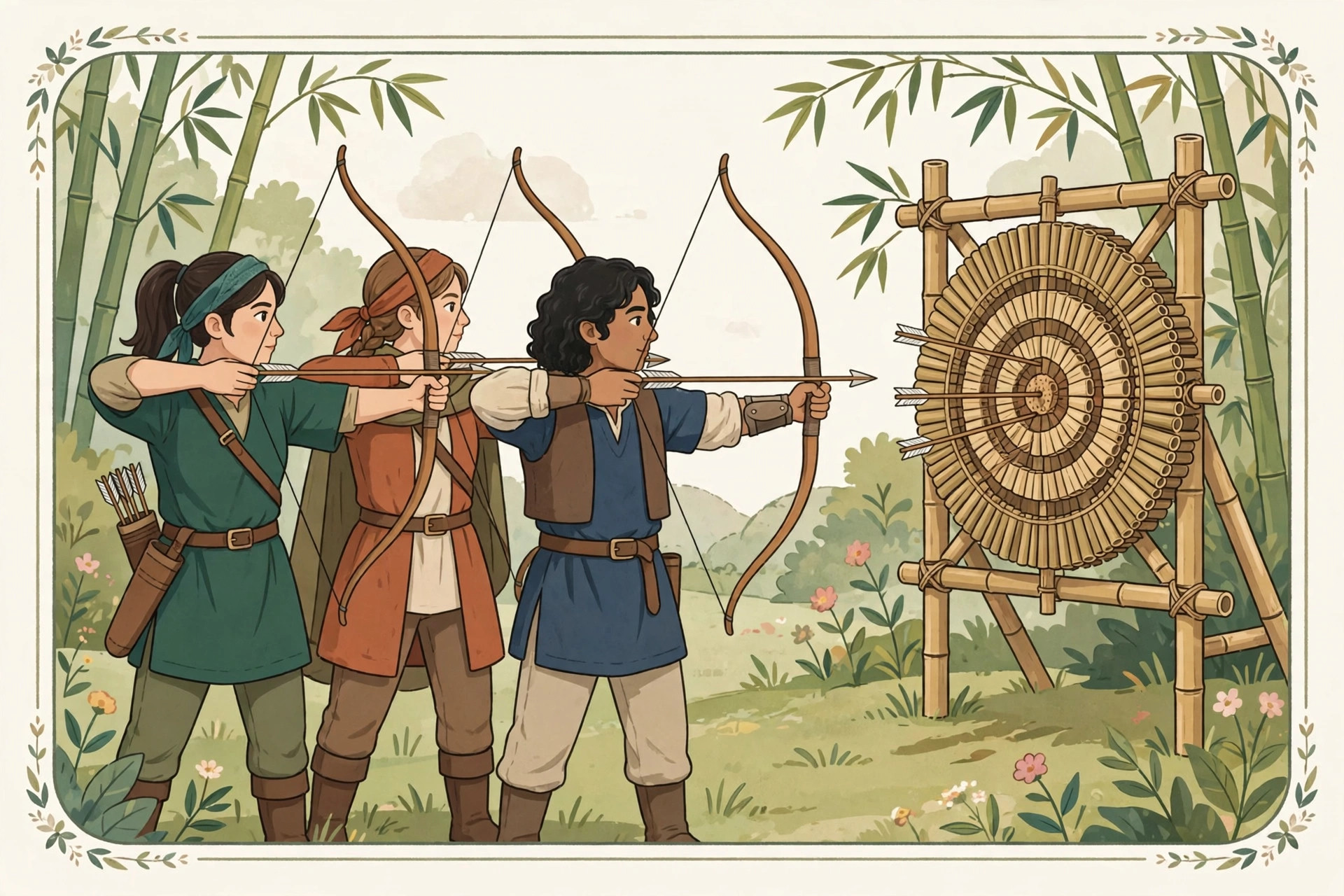
The Khasi people of Meghalaya have practiced archery for centuries. It is tied to festivals, village life and community identity, not merely to sport. Archers traditionally shoot handmade bamboo arrows at a cylindrical target made of bundled bamboo, and contests between villages drew large crowds. Informal wagering among spectators was part of the culture, a local custom that predates modern gambling law by generations.
The problem of unregulated betting
As towns grew and the betting around archery contests became organized, the informal system began to cause problems. Large sums changed hands outside any legal framework. Disputes over winnings had no forum. The state collected nothing from an activity that was clearly commercial in scale. The question facing the government was the one many states face with popular games of chance: suppress it entirely, or bring it inside the law with rules, licences and taxes.
The legalization timeline
Meghalaya chose regulation. The key milestones are:
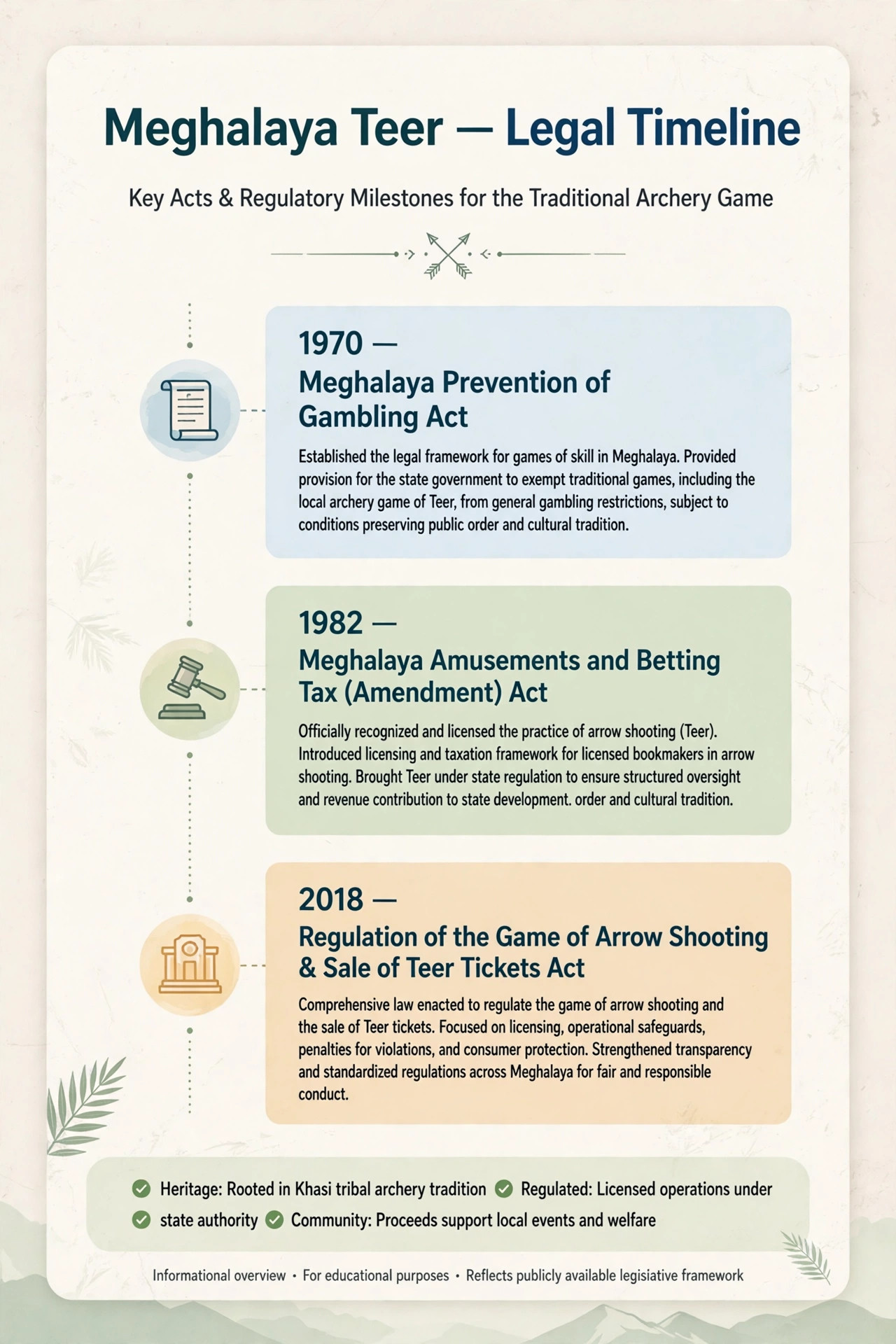
1970 – The Meghalaya Prevention of Gambling Act. This general anti gambling statute gave the state government the power to exempt notified games from its prohibitions. That exemption power is the legal door through which teer eventually passed.
1982 – The Meghalaya Amusements and Betting Tax (Amendment) Act. This is the decisive legalization step. Section 14A of this Act licenses betting on arrow shooting, defines licensed bookmakers for that purpose, and declares that “arrow shooting” includes the game of teer. With this single provision, teer stopped being an unregulated wager and became a licensable activity.
2018 – The Meghalaya Regulation of the Game of Arrow Shooting and the Sale of Teer Tickets Act. As the game grew, the state enacted a dedicated regulatory statute covering the conduct of the game and the sale of teer tickets, giving the framework its modern detailed form.
This timeline is worth remembering because it answers the most common question about the game in one sentence: teer is legal in Meghalaya because state statutes specifically license and regulate it.
Section 14A of the 1982 Act and Licensed Bookmakers
The Meghalaya Amusements and Betting Tax (Amendment) Act, 1982 is the foundation stone. Before 1982, teer existed only as custom. After 1982, it existed as law.
What Section 14A provides
Section 14A is the heart of the legal framework. It licenses betting on arrow shooting in Meghalaya. It creates the category of the licensed bookmaker for arrow shooting, which is the legal person who is authorized to accept bets on teer. And it removes all doubt about scope by providing that “arrow shooting” includes the game of teer, so the licensing, taxation and enforcement machinery of the Act applies to teer counters without ambiguity.
The provision works in tandem with the rest of the Act, which imposes a betting tax. That means the licence is not a mere permission slip. It is part of a revenue system: the bookmaker is licensed, the bets are recorded, and tax is levied on the betting. The full text of the Act is published on the official state portal, which is the authoritative source for anyone who wants to read the exact provisions. You can read it through the official text of the Meghalaya Amusements and Betting Tax (Amendment) Act, 1982 on the Meghalaya state portal.
Who can be a licensed bookmaker
The licensed bookmaker is the legal actor at the center of meghalaya teer. A bookmaker is a person authorized by the state to accept bets on arrow shooting and to sell teer tickets. The licence defines where the counter may operate, ties the operator to the tax system, and subjects the operation to inspection and enforcement.
This is an important distinction for players. A bet placed with a licensed bookmaker at an authorized counter is a transaction inside the legal framework, with the protections that licensing brings. A bet placed with an unlicensed operator outside the system is not covered by these protections. The 1982 Act therefore does more than legalize teer. It draws a line between the legal game and the illegal one, and that line is the licence.
Why the definition of “arrow shooting” matters
Legislative definitions matter more than they appear to. By stating that “arrow shooting” includes the game of teer, Section 14A made sure that none of the Act’s machinery could be sidestepped by arguing about names. Whether a counter calls the activity archery betting, teer, or arrow shooting, it falls under the same licensing and taxation regime. That drafting choice closed the loophole before it could be used.
The 2018 Regulation of Arrow Shooting and Sale of Teer Tickets Act
If the 1982 Act built the house, the Meghalaya Regulation of the Game of Arrow Shooting and the Sale of Teer Tickets Act, 2018 furnished its rooms. This statute takes the framework from the broad licensing idea of Section 14A to the detailed day to day regulation of the game and of teer ticket sales.
Regulation of the game itself
The 2018 Act addresses how the game of arrow shooting is conducted as a licensed activity. Teer sessions are organized shooting events: archers shoot arrows at a target over a fixed number of arrows per round, and the total number of arrows striking the target determines the winning number. The Act’s regulatory scope covers the organization and conduct of these sessions, ensuring that the game runs in an orderly, supervised manner consistent with the licensing system.
The Law Commission of India examined this framework in its Report No. 276 on gambling and sports betting in India, which discusses the Meghalaya regime. Readers who want the national policy context can consult the Law Commission of India Report No. 276, Meghalaya section, which places the Meghalaya statutes in the broader Indian legal landscape.
Sale of teer tickets
Ticket sales are the commercial heart of the game, and the 2018 Act regulates them directly. Tickets are sold by licensed counters in fixed denominations during a defined sale window before each round. The price of a ticket and the record of sales connect the player to the licensed system: the ticket is the evidence of a lawful bet, and the counter that sells it is accountable to the state.
For the player, the practical message is simple. Buy tickets only from licensed counters during official sale hours, keep the ticket until results are declared, and understand that only the licensed channel carries legal protection.
How Licensing of Teer Counters Works
Licensing is the mechanism that turns a statute into a working market. Here is how the system functions in practice.
Step 1 – Application to the authorities
A person or entity that wishes to operate a teer counter applies to the competent authority under the licensing provisions. The application identifies the operator, the proposed location of the counter, and the sessions the operator intends to cover.
Step 2 – Verification and grant of licence
The authorities verify the applicant and the premises. A licence, once granted, authorizes the holder to accept bets on arrow shooting and to sell teer tickets at the specified counter, subject to the conditions of the licence and the governing statutes.
Step 3 – Ongoing compliance
The licence is not a one time event. Licensed bookmakers operate within the betting tax system, maintain records of sales, and are subject to inspection and enforcement. Operating without a licence, or outside the terms of a licence, exposes the operator to the penalties of the gambling laws that the licensed system exists to replace.
The role of the Khasi Hills Archery Sports Association
Teer is conducted under the aegis of the Khasi Hills Archery Sports Association, which organizes the archery side of the game. The association’s role connects the licensed betting framework to the sporting tradition from which teer grew: the archers shoot, the association oversees the sporting conduct, and the licensed bookmakers handle the wagering around it. This division of responsibility is one of the distinctive features of the meghalaya teer system.
Betting Tax and Where the Money Goes
Legalization was never only about order. It was also about revenue, and the betting tax is how the state captures it.
The tax on betting
The 1982 Act is, as its name says, an Amusements and Betting Tax statute. Betting on arrow shooting is brought into the tax net along with the licensing. The licensed bookmaker’s operations generate tax liability, and the state collects it as part of its ordinary revenue machinery.
Where the money goes
Betting tax revenue flows into the public finances of Meghalaya. Like other state tax revenue, it supports public expenditure: administration, services and development in the state. This is the fiscal argument that justified legalization in the first place. An activity that was happening anyway, generating no revenue and no oversight, was converted into a regulated trade that contributes to the state exchequer.
Why the tax matters to players
The tax is also a signal to players about legitimacy. A counter that operates inside the tax system is a counter the state knows about. Unlicensed operators, who pay no tax and hold no licence, offer no such assurance. The tax system is therefore not just a revenue tool. It is part of the consumer protection that licensing provides.

Meghalaya Teer Rules Every Player Should Know
The statutes create the framework. The rules are what players live by. This section covers the game format, the age rule, and prizes in the general terms that the licensed system uses.
How the game format works
Each teer session is organized around archery rounds. Bettors choose a number from 0 to 99, representing the last two digits of the total arrows hitting the target in a round. If the total arrows hitting the target is, for example only, shown as “-“, the winning number would be the last two digits of that total, labeled here as example only and not a real result. Two rounds per session are called the first round (FR) and the second round (SR). Tickets are sold separately for each round, and results are declared for each round after the shooting is complete.
The shooting itself follows the traditional form: archers aim at a cylindrical target, and the count of arrows striking it is the basis of the result. The licensed system ensures the count is conducted openly and declared publicly, which is one of the core integrity features of the legal framework.
The 18+ age rule
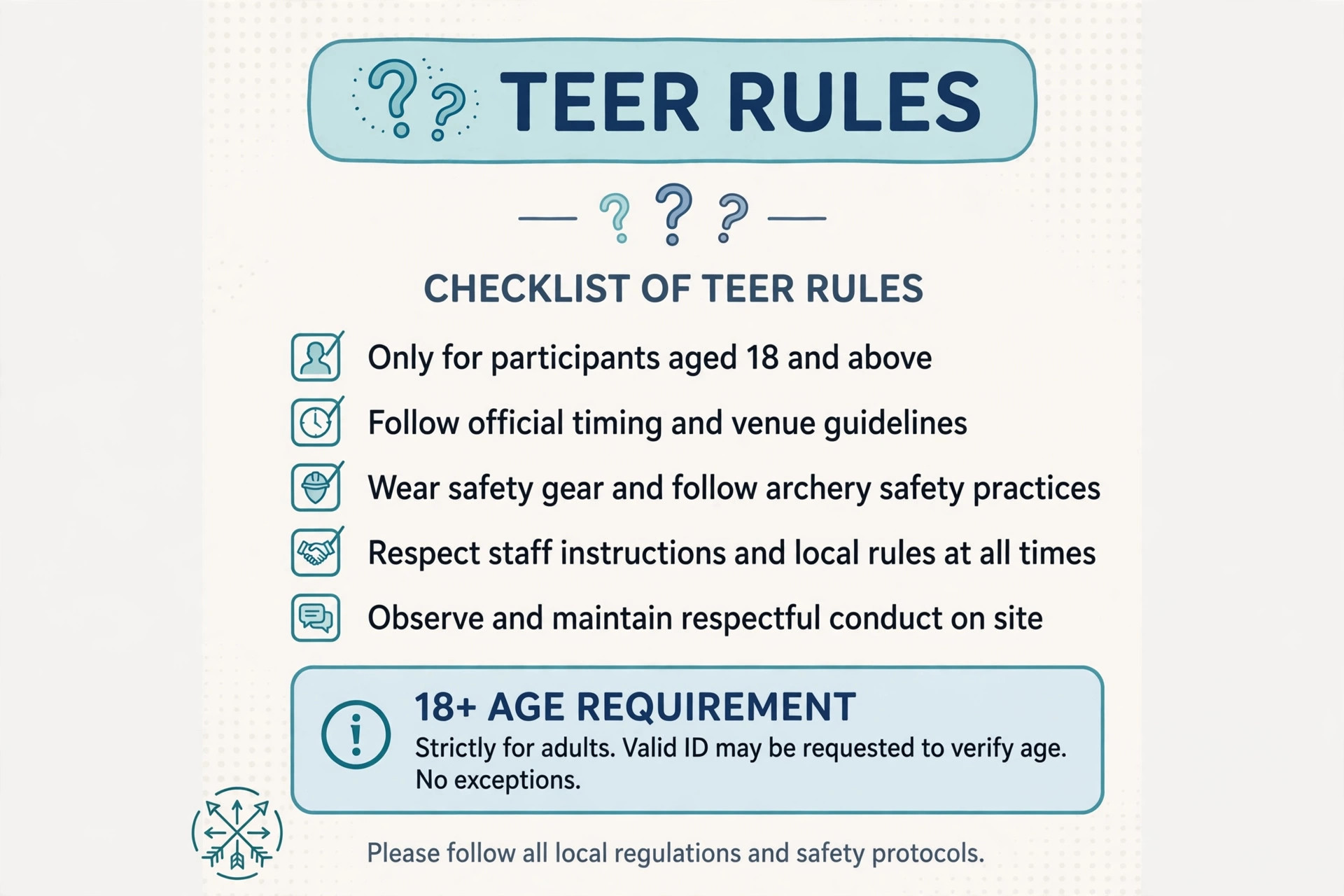
Teer is a legal lottery in Meghalaya for adults aged 18 and above only. Minors may not buy teer tickets, and licensed counters are expected to enforce the age limit. This is a standard feature of regulated lotteries and betting worldwide, and it applies to meghalaya teer without exception. Parents and guardians should treat this rule as absolute.
Teer prizes in general terms
Prizes in teer are set by the licensed counter as a fixed multiple of the stake. A winning ticket pays out at the multiple that the counter has established for that round. Because the multiple is a commercial term set within the licensed system, players should confirm the applicable payout terms at the counter where they buy tickets, and understand them before playing. What the legal framework guarantees is the structure: licensed counters, recorded sales, and publicly declared results. It is the ticket bought at a licensed counter that entitles the holder to the stated payout.
Responsible play
Teer is a legal lottery in Meghalaya for adults 18+ only. Play responsibly. Set a budget before you buy a ticket, never bet money you cannot afford to lose, and treat teer as entertainment, not as a source of income. If betting stops being fun, stop betting. The legal framework exists to keep the game orderly and supervised, but the responsibility for sensible play belongs to each adult player.
Frequently Asked Questions About Meghalaya Teer Legality
Is teer legal in Meghalaya?
Yes. Teer betting in Meghalaya is licensed under Section 14A of the Meghalaya Amusements and Betting Tax (Amendment) Act, 1982, which defines licensed bookmakers for arrow shooting and states that “arrow shooting” includes the game of teer. The Meghalaya Regulation of the Game of Arrow Shooting and the Sale of Teer Tickets Act, 2018 further regulates the game and ticket sales. It is a licensed and taxed lottery, not an underground game.
Is teer legal outside Meghalaya?
The licensing framework described in this guide is Meghalaya state law. Gambling and betting laws in India are largely state subjects, and the legal position of betting on teer in other states depends on the laws of those states. This article covers the Meghalaya framework only, and readers in other states should check their own state law.
What is Section 14A of the 1982 Act?
Section 14A of the Meghalaya Amusements and Betting Tax (Amendment) Act, 1982 is the provision that licenses betting on arrow shooting. It creates the licensed bookmaker category for arrow shooting and expressly provides that “arrow shooting” includes the game of teer, bringing teer counters inside the licensing and betting tax system.
What does the 2018 Teer Tickets Act regulate?
The Meghalaya Regulation of the Game of Arrow Shooting and the Sale of Teer Tickets Act, 2018 regulates the conduct of the game of arrow shooting and the sale of teer tickets. It is the detailed regulatory statute that sits on top of the 1982 licensing foundation, governing how sessions are run and how tickets are sold through licensed counters.
Who organizes the archery side of teer?
Teer is conducted under the aegis of the Khasi Hills Archery Sports Association. The association oversees the sporting conduct of the archery sessions, while licensed bookmakers handle the wagering under the statutes. This pairing of a sports body with a licensing regime is distinctive to the Meghalaya system.
How old must you be to play teer?
You must be 18 years or older. Teer is a legal lottery in Meghalaya for adults 18+ only, and licensed counters enforce the age limit. Always play responsibly and within your means.
How are teer prizes calculated?
Prizes are paid as a fixed multiple of the stake, set by the licensed counter. Confirm the payout terms at the counter before buying a ticket. Only tickets bought from licensed counters carry the protections of the legal framework.
Where does teer betting tax go?
Betting tax collected under the 1982 Act flows into Meghalaya’s public revenue, supporting state expenditure and development. Legalization converted an untaxed informal trade into a regulated contributor to the state exchequer.
Conclusion
Meghalaya teer stands apart from most games of chance in India because its legality is not a grey area or a tolerated custom. It is written into statute. Section 14A of the Meghalaya Amusements and Betting Tax (Amendment) Act, 1982 licenses betting on arrow shooting and names teer expressly. The 2018 Regulation of Arrow Shooting and Sale of Teer Tickets Act regulates the game and the tickets in detail. The Meghalaya Prevention of Gambling Act, 1970 provides the exemption mechanism that lets the state carve out notified games. Licensed bookmakers operate counters, pay betting tax, and sell tickets to adults aged 18 and over, while the Khasi Hills Archery Sports Association oversees the sporting side.
For readers who want to follow the game itself, the All Teer Results homepage carries daily coverage, the teer result list archives past sessions, and the about us page explains how this site reports on teer. Questions about this guide can be sent through the contact page.
Teer shows what happens when a state chooses regulation over prohibition: a centuries old Khasi tradition, kept alive in its archery form, organized into a licensed lottery that is taxed, supervised and open. Play only through licensed counters, play only if you are 18 or older, and always play responsibly.