
If you have ever stood near the Polo Ground in Shillong on a weekday afternoon, you have heard it before you have seen it: a soft ripple of voices, then the faint hiss of arrows leaving bows, then a pause while men walk out to the targets and count. That rhythm, repeated twice every session, is the heartbeat of the game. To understand how teer rounds work is to understand this rhythm, because everything else in teer, the tickets, the counters, the result lists, the famous two numbers you see every day, flows from the simple fact that the game is played in two rounds.
This guide walks you through both rounds the way you would experience them in person, from the moment tickets go on sale to the moment the second round number goes up on the board. No jargon, no shortcuts, and no made-up numbers. Just the real structure of the teer first round and the teer second round, so you can read any result list with confidence.

How Teer Rounds Work in Plain Language
At its core, teer is an archery contest that doubles as a legal lottery. Licensed archers shoot arrows at a bamboo target from a fixed distance, and the total number of arrows that hit the target becomes the basis for the winning number. The game never does this just once per session. It does it twice. The first attempt is called the first round, shortened to FR. The second attempt is called the second round, shortened to SR.
That is the whole secret behind the teer FR SR meaning people keep asking about. FR simply means the number drawn from the first round of shooting. SR means the number drawn from the second round of shooting. They are two separate rounds of the same session, and each one produces its own winning number. When you look at a result list, you are always looking at pairs: an FR number and an SR number, side by side.
How Many Rounds in Teer
One session always has two rounds. That is a fixed rule of the game, not a habit. But a full day has more than one session. In Shillong, there is the well-known day session at the Polo Ground. There are also morning teer sessions run by different associations, and there are night teer sessions that play out in the evening. Each of these sessions runs its own first round and its own second round, and each round declares its own result.
So when someone asks how many rounds in teer, the honest answer has two layers. Each session has exactly two rounds, FR and SR. Across a full playing day, you will see several sessions, which means several pairs of FR and SR results. This is why result lists look busy: they are stacking the FR and SR pairs of multiple sessions, one after another.
Why the Game Needs Two Rounds
The two-round format is not an accident of history. It gives players two chances per session instead of one, and it gives the archers a second complete attempt after the first set of results is known. For the associations running the game, it also keeps the daily rhythm steady: tickets for the second round can be sold while the first round is being shot and counted, which keeps counters and counters’ queues moving all afternoon. For you as a reader of results, the two rounds simply mean that every session hands you two numbers to read, not one.
The Teer First Round, Step by Step
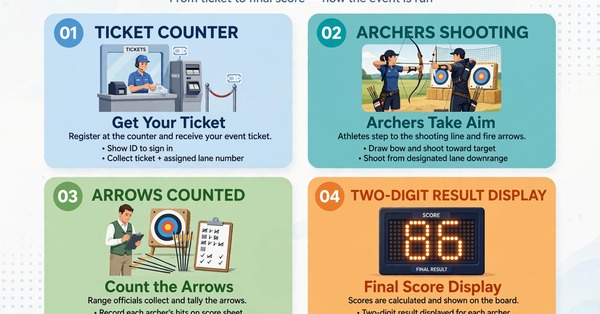
Let us slow down and walk through the teer first round the way it actually unfolds. Picture the ground in the early afternoon. The counters around the area have been selling tickets since the morning, and each ticket carries a two-digit number of the buyer’s choice, from 00 to 99. Tickets for the first round are sold separately from tickets for the second round, and a player can buy either or both.
Archers Take Their Positions
A fixed group of licensed archers, typically around fifty in the well-known Shillong day session, lines up at the shooting line. The targets, bundles of bamboo straw, sit at the far end of the ground. When the signal comes, each archer looses a fixed quota of arrows, commonly thirty in the first round, at the target. The whole shooting phase lasts only a few minutes. It is quiet, focused work, and the crowd watches in near silence.
The Counting
Once shooting stops, officials walk out to the targets and count every arrow that struck and stuck. Arrows that missed the target or fell off do not count. The total is added up across all archers, and this is where the famous rule comes in: only the last two digits of the total become the winning number. As an illustration, example only, not a real result: if the counters tally 1,247 arrows on the targets, the declared number is 47, and if they tally 902, the number is 02. This is the teer FR result, and it is announced publicly, written up on boards, and carried to the counters and result publishers within minutes.
Notice what this means. Nobody picks the winning number in advance, and nobody votes on it. The number emerges from the shooting itself. That is why teer fans describe the game as a contest first and a lottery second. The archers’ skill is real, the counting is supervised, and the last-two-digits rule turns a big, messy total into a neat two-digit result.
The Teer Second Round, Step by Step
After the first round is declared, the session does not end. It resets. The teer second round is a fresh round of shooting with its own tickets, its own arrows, and its own number.
What Changes in the Second Round
The format is the same but the scale is smaller. Fewer archers take part in the second round, commonly around thirty in the day session, and each shoots a smaller quota of arrows, commonly twenty. The targets are the same, the distance is the same, and the counting rule is identical: the last two digits of the total number of arrows on the targets become the winning number. This is the teer SR result.
One practical difference matters to players. Tickets for the second round are sold during the gap after the first round, which means a player who skipped the first round can still join the second. It also means the second round has its own pool of tickets and its own payout calculations, completely independent of the first round. Winning on FR does not affect SR, and a number that hit in FR has no special status in SR. They are two independent rounds.
The Gap Between the Rounds
The interval between the two rounds is usually around an hour, long enough to sell second-round tickets, let the archers rest, and clear the targets. If you are following results from home, this gap is the part of the afternoon when the FR result is already out and everyone is waiting on SR. Result publishers, including the lists here on All Teer Results, typically show the FR number first and fill in the SR number as soon as it is declared.
How Teer Rounds Work Across Markets: Timing
Teer round timing follows the sun. Morning sessions declare their rounds in the morning hours, the main day sessions declare in the afternoon, and night sessions declare in the evening. The exact declaration times differ from market to market, and they can shift slightly on special days, so treat any specific time you see as approximate rather than a promise.
For the best-known Shillong day session, the first round result usually lands in the mid-afternoon and the second round result follows about an hour later, in the late afternoon. Morning teer sessions, such as the Khanapara and Juwai morning games, run the same two-round format earlier in the day, with their FR and SR declared before noon. Night teer sessions repeat the pattern in the evening. Sunday is a rest day across the board, with no rounds played, which is why result lists always show a gap on Sundays.
If you are new, the simplest way to keep this straight is to think in sessions, not in clock times. Ask “which session’s rounds am I looking at?” before you ask “what time?” The answer is always one session, two rounds, two numbers.
The People Who Run the Rounds
The rounds do not run themselves. In Shillong, the game is organized by the Khasi Hills Archery Sports Association, known as KHASA, a body of archery clubs that has overseen the sport for decades. KHASA licenses the archers, approves the counters, appoints the officials who supervise the counting, and works within the framework of Meghalaya’s state lottery regulations. Similar associations run the game in Juwai and Khanapara under their own local structures.
On the ground, three groups make each round happen. The archers, many of whom practice year-round, do the shooting. The counters, licensed booth operators, handle ticket sales and pay out winnings according to the declared numbers. The officials manage the target area, verify the arrow counts, and announce the results. When a round’s number goes up on the board, it has passed through all three groups. That chain of hands is part of why players trust the FR and SR numbers they see each day.

How to Read a Teer FR Result and Teer SR Result
Now that you know the mechanics, reading a result list is easy. Every row for a session shows two numbers: FR and SR. The FR number came from the first round of shooting that session. The SR number came from the second round. Together they are the complete result of that session.
Here is a worked example with made-up numbers, example only, not a real result. Suppose the Shillong day session row reads FR: 47, SR: 02. That tells you the first round’s arrow count ended in 47 and the second round’s count ended in 02. Nothing more, nothing less. The two numbers do not combine into a four-digit figure, they do not predict each other, and one does not cancel the other. If you held a ticket with 47 on it for the first round, you won the first round. If you held 02 for the second round, you won the second round.
When a round has not been shot yet, honest result lists show a placeholder such as a dash rather than guessing. A dash for SR while FR shows a number simply means the second round is still to come. Be wary of any site that fills in both numbers before both rounds have been played.
Tickets, Counters, and Prizes
Understanding how teer rounds work is incomplete without the ticket side, because the rounds exist to give ticket holders something to play. Tickets are sold at licensed counters, small booths authorized by the organizing association, at prices that typically range from ten to one hundred rupees depending on the type of bet. You choose your two-digit number, pay, and receive a printed ticket.
The standard prize structure pays out for a direct hit on the round’s declared number. The exact payout multiples are set by the association and can differ between markets, so check the rules posted at your counter rather than relying on word of mouth. What is fixed is the independence of the rounds: an FR ticket only plays the FR round, an SR ticket only plays the SR round, and you must hold a ticket for the round whose number you want to win.
A quick responsible-play note belongs here. Teer is a legal lottery only in Meghalaya, where it is regulated by the state government under the Meghalaya Amusements and Betting Tax Act, and participation is for adults aged 18 and above. Set a budget before you play, treat it as entertainment, and never chase losses. You can read more about the legal framework on the Meghalaya government portal and the background of the game on Wikipedia’s Teer article.
Frequently Asked Questions
What does FR mean in teer result?
FR stands for first round. It is the winning number produced by the first round of archery shooting in a session. Every session declares an FR number before it declares an SR number, because the first round is always shot and counted first.
What does SR mean in teer result?
SR stands for second round. It is the winning number produced by the second round of archery shooting in a session, played after the first round with a fresh set of archers and tickets. The SR number is completely independent of the FR number.
How many rounds are there in one teer session?
Exactly two: the first round and the second round. This is true for every session, whether it is a morning session, the main day session, or a night session. Multiple sessions run each day, so a daily result list shows several FR and SR pairs.
Can I play only the second round and skip the first?
Yes. Tickets for the two rounds are sold separately. Many players buy tickets for just one round, and second-round tickets are typically on sale during the gap after the first round result is declared. An SR ticket only plays the SR round.
Why do the two rounds have different numbers of archers?
The second round is traditionally a smaller, quicker affair: fewer archers, each shooting fewer arrows. The exact counts are set by the organizing association and can vary between markets. The important part is that the counting rule, last two digits of the total arrows on target, is the same in both rounds.
Do FR and SR numbers ever repeat?
They can. Because each round is an independent event, the same two-digit number can appear as the FR result one day and the SR result another day, or even as both FR and SR of the same session. A repeat is a coincidence, not a pattern, and no round influences the next.
What happens on Sundays?
No teer rounds are played on Sundays. Counters stay closed and no FR or SR results are declared. Result lists show the gap, and play resumes on Monday with the usual sessions and rounds.
Conclusion
The two-round system is teer in miniature: a contest of archery, counted in the open, turned into two numbers by one simple rule. Once you know that FR means the first round’s shooting and SR means the second’s, that tickets are sold separately for each, and that every session gives you exactly these two numbers, the whole result list clicks into place. Keep an eye on our daily result lists for every session’s FR and SR pairs, check the Shillong teer result page for the main day session, and start from the All Teer Results homepage whenever you need the full picture for the day.