
If you have ever stared at a two-digit Shillong Teer result and wondered where that number actually comes from, you are asking exactly the right question. Understanding how teer result is calculated takes the mystery out of the game and replaces guesswork with genuine knowledge. The answer is refreshingly physical. There is no computer draw, no spinning drum of balls, and no random number generator humming in a back room. The number comes from real archers, real bamboo bows, and real arrows counted by hand at the Polo Ground in Shillong, Meghalaya.
Every day the game is played, dozens of skilled archers line up and shoot a fixed number of arrows at a traditional target. Officials then count how many arrows actually struck the target, write the total down, and take the last two digits of that total. Those two digits are the result for that round. That is the entire teer result calculation in one paragraph, and the rest of this guide walks you through every detail: the ground, the rounds, the counting, the verification, and how the number reaches your screen.
What “Calculated” Really Means in Teer
In most lotteries, a result is “drawn” from a machine or a set of balls. In Teer, the result is calculated in the oldest sense of the word: people count physical objects and do simple arithmetic. The objects are arrows. The arithmetic is a tally plus a two-digit truncation. Nothing about the teer result calculation involves electronics or algorithms.
The game is organized by the Khasi Hills Archery Sports Association, a body of archery clubs from the Khasi Hills region. On playing days, the association’s archers gather at the Polo Ground in Shillong, a well-known sports field in the heart of the city. Ticket sellers across Meghalaya sell numbered tickets from 00 to 99 before each round begins. When the round is shot and the arrows are counted, the last two digits of the count decide which ticket number wins.
This matters because it tells you what the result depends on and what it does not depend on. It depends on human archery skill, wind, light, nerves, and the simple fact that some arrows miss. It does not depend on any pattern in past results, any formula you can apply at home, or any insider information. Each round is a fresh physical event.
The Ground Where It Happens
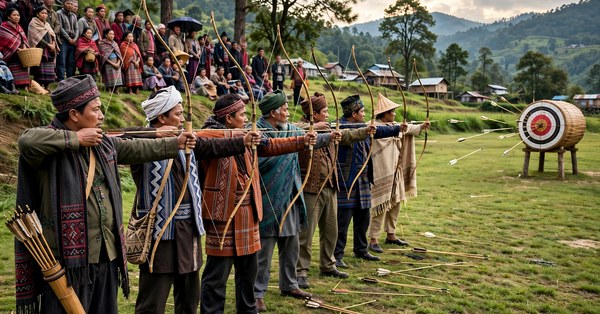
The Polo Ground in Shillong is the beating heart of Shillong Teer. This open field in the Lachumiere area of the city hosts the archery sessions that produce the daily results. If you visit on a playing afternoon, you will see something that looks more like a traditional sporting event than a lottery draw: rows of archers in club colors, a cylindrical target made of bundled straw set at a distance, and a crowd of onlookers watching each volley.
The target itself deserves a description, because it is central to teer arrow counting. It is not a flat paper board like the ones used in Olympic archery. It is a tall cylinder of tightly bound straw, standing upright, with a small marked zone. Archers shoot from a marked line a fixed distance away. An arrow counts only if it sticks into the target. Arrows that fall short, sail wide, or bounce off do not count. This strict definition is what makes the counting honest and repeatable.
Around the ground, the association sets up a counting area, usually a roped-off section with tables where officials work. Spectators can watch the shooting, and the counting happens in the open, in front of witnesses. That openness is part of the game’s credibility.
The Two Rounds of the Day
Shillong Teer is played in two rounds each playing day, called the First Round and the Second Round. Each round is a complete, independent event with its own shooting, its own counting, and its own result. The two rounds use the same archers and the same method, but the numbers are separate. A ticket bought for the First Round has nothing to do with the Second Round’s count.
How the First Round Works
In the First Round, the archers shoot a larger number of arrows. Traditionally, around fifty archers take part, and each shoots a set of arrows, commonly thirty per archer in the first session. That means roughly fifteen hundred arrows leave the bows in the First Round. Of those, only the ones that strike and stick in the target are counted.
The shooting does not happen all at once in a chaotic hail. Archers shoot in an organized manner, and when the volley is complete, officials move in to collect and count. The First Round result is declared in the afternoon, after the counting and verification are finished.
How the Second Round Differs
The Second Round follows the same procedure but with fewer arrows per archer, commonly twenty per archer in the second session. With the same group of archers, that means roughly one thousand arrows in the Second Round. Fewer arrows means a smaller total count, but the method is identical: count the hits, take the last two digits.
The Second Round result is declared in the evening, after its own separate counting. Because the two rounds are independent, the First Round’s total tells you nothing about what the Second Round will produce. They are two separate physical events, and the archers’ arms are a little more tired the second time around, which is part of the game’s honest unpredictability.
How Teer Result Is Calculated Step by Step
Here is the teer draw counting procedure broken into the exact steps the officials follow. This is the core of how teer result is calculated, and every authorized Teer venue follows the same logic.
Step 1 – Collect the Arrows
After the shooting stops, officials walk to the target and carefully pull out every arrow that is stuck in it. Arrows lying on the ground around the target, arrows that glanced off, and arrows that never reached are left out of the count. Only arrows embedded in the target qualify. This is the first and most important filter in the whole process.
Step 2 – Sort and Bundle
The collected arrows are gathered into bundles for counting. Depending on the venue’s practice, officials may count in groups, ten at a time, marking tally sheets as they go. The physical handling is deliberately slow and visible. Rushing this step would invite mistakes, so the counters work methodically while observers watch.
Step 3 – Tally the Total
Every qualifying arrow is tallied into a grand total for the round. If the archers shot, say, fifteen hundred arrows and nine hundred and forty-seven struck the target, the tally for the round is 947. The tally is recorded on official sheets and cross-checked. More than one person counts, and the figures must agree before the process moves on.
Step 4 – Take the Last Two Digits
This is the famous final step of the teer result formula. From the grand total, only the last two digits are kept. A total of 947 becomes 47. A tally of 1,023 becomes 23. A total of exactly 1,100 becomes 00. Those two digits are declared as the winning number for the round.
That is the complete archery teer result method. Four steps, no electronics, no hidden variables. The beauty of it is that anyone standing at the ground could, in principle, follow along with the count.
How Teer Result Is Calculated: A Worked Example With Sample Numbers
Let us walk through a fully labeled example so the method is crystal clear. Remember: every number below is an example only, not a real result.
Suppose the First Round at Polo Ground proceeds like this:
- Archers participating: 50 (example only)
- Arrows shot per archer: 30 (example only)
- Total arrows shot: 1,500 (example only)
- Arrows that hit and stuck in the target: 863 (example only, not a real result)
- Arrows that missed: 637 (example only)
The officials tally 863 qualifying hits. They take the last two digits: 63. The declared First Round result would be 63 in this imaginary scenario. A ticket numbered 63 would be the winning ticket.
Now the Second Round, same imaginary day:
- Archers participating: 50 (example only)
- Arrows shot per archer: 20 (example only)
- Total arrows shot: 1,000 (example only)
- Arrows that hit: 742 (example only, not a real result)
The last two digits of 742 are 42, so the imaginary Second Round result would be 42. Notice how the two rounds produce completely different numbers from completely different counts. That independence is a defining feature of the game.

Who Counts, and Who Watches the Counters
A fair count needs more than honest archers. It needs a system of people checking each other. The Khasi Hills Archery Sports Association appoints officials for each session, and the counting team typically includes counters who handle the arrows, recorders who write the tallies, and supervising judges who verify the figures.
The roles break down roughly like this. The counters do the physical work of pulling arrows and grouping them. The recorders maintain the tally sheets and call out running totals. The supervisors compare the independent counts and confirm the final figure before it is announced. At many sessions, representatives of the archery clubs are present as witnesses, and the whole procedure happens in view of the spectators.
If two counters disagree, the arrows are recounted. The declared number only goes out when the counting team agrees on the total. This redundancy is simple but effective, and it is one reason the game has kept public trust for decades.
How the Number Travels From the Ground to Your Screen
Once the total is agreed and the last two digits are taken, the result is announced at the ground itself. From there, it spreads through the authorized network: the association’s notice boards, licensed ticket counters, and then the many result websites and apps that republish it, including this one. When you check the Shillong Teer result page here, you are seeing the number that was counted by hand at Polo Ground that same day.
Because the result passes through several hands on its way to the internet, it is wise to cross-check any number that matters to you against more than one source. Our teer result list archive lets you review past declared numbers, and the homepage always shows the latest updates for every market we track, including Juwai Teer and Khanapara Teer.
Why the Last Two Digits, and Not the Whole Total
Newcomers often ask why the game does not simply declare the full count, like 863, as the result. The answer is practical. Tickets are sold as two-digit numbers from 00 to 99, a format that is easy to print, easy to sell, and easy for players to choose. Taking the last two digits maps any possible arrow total onto that 00 to 99 ticket range.
This design also keeps every round playable in the same way. Whether the archers have a sharp day with many hits or a windy day with fewer, the result is always a two-digit number and the tickets work the same way. The ticket format came first, and the last-two-digits rule is the bridge between the physical count and the ticket.
What Does Not Affect the Count
Because the method is physical, a lot of popular beliefs about influencing the result simply do not apply. Past results do not change how many arrows will hit the target today. The day of the week does not change the archers’ aim. No calculation done at home can predict how many arrows out of fifteen hundred will stick in a straw cylinder on a given afternoon, because that depends on wind, light, fatigue, and human skill in the moment.
This is worth stating plainly because many websites sell “sure numbers” and “target predictions.” The counting method itself is the reason those promises are empty. If the result comes from arrows counted by hand, nobody can know it before the arrows are shot. Anyone claiming otherwise is selling you something the method makes impossible.

The Legal Frame Around the Counting
Teer is a legal, state-regulated lottery in Meghalaya, operated under the state’s taxation and amusement laws with oversight from the state government. The archery sessions that produce the results are organized sporting events run by the recognized archery association, not informal gatherings. That legal standing is what allows tickets to be sold openly and results to be published.
For players, the practical notes are simple. Teer is strictly for adults aged 18 and above. If you play, set a budget you can afford to lose and treat it as entertainment, not income. The counting is honest, but the outcome of any round is genuinely uncertain, and no amount of studying past numbers changes that.
For background reading, the Wikipedia article on Teer gives a clear public overview of the lottery’s mechanics, and the Meghalaya government portal is the official source for the state’s administrative and regulatory framework.
Frequently Asked Questions
How is the Shillong Teer winning number decided?
The winning number is decided by counting arrows. After each round, officials count every arrow that struck and stuck in the target, tally the total, and take the last two digits. Those two digits are the winning number for that round.
How many arrows are shot in each round?
In the traditional format, around fifty archers participate. Each archer shoots about thirty arrows in the First Round and about twenty in the Second Round. Only the arrows that hit the target are counted toward the total.
Do missed arrows count in teer result calculation?
No. Arrows that miss the target, fall short, or bounce off are excluded. The teer result calculation uses only arrows that are embedded in the target when the shooting stops. Misses are simply left out of the tally.
What happens if the total ends in 00?
If the grand total is a round number like 1,100 or 900, the last two digits are 00, and the declared result is 00. The number 00 is a valid ticket number, so it wins exactly like any other number.
Are the First Round and Second Round counted separately?
Yes. Each round has its own shooting session, its own arrow count, and its own declared number. The two totals are never combined or averaged. They are independent results from independent rounds.
Who verifies that the counting is correct?
Officials appointed by the Khasi Hills Archery Sports Association supervise the count. Multiple counters tally independently, recorders keep the sheets, and supervisors confirm the agreed total before the result is announced. Club representatives and spectators witness the process.
Can the result be known before the counting finishes?
No. Because the number comes from arrows shot and counted by hand, it cannot exist before the shooting happens. Any claim of advance knowledge contradicts the physical method itself.
The Short Version
How teer result is calculated comes down to one honest physical process: archers shoot, officials count the arrows that hit the target, and the last two digits of the total become the winning number. Two rounds a day means two separate counts and two separate numbers, each verified by appointed officials at the Polo Ground in Shillong. Now that you know the method, you can read any Teer result with a clear picture of exactly how that number came to be. Check today’s declared numbers on our Shillong Teer result page, browse the teer result list archive, or start from the homepage for every market.