
Picture Shillong in the early afternoon. The mist has burned off the hills, shopkeepers are arranging their counters, and at ticket stalls across the city people are buying slips for a game that has run here for generations. If you have ever wondered how teer draw works, the short answer is simple: skilled archers shoot arrows at a target, officials count how many arrows stick, and the last two digits of that count become the result. The longer answer is far more interesting, because the teer draw process is a living tradition, a legal lottery, and a logistical operation that repeats almost every day of the week.
This guide walks you through the complete journey from arrows to result. You will see what happens on the ground before the first arrow is shot, how the shooting itself is organized, how the counting is done, how the two rounds fit together, and how the final number travels from the ground to millions of players. Nothing here involves predictions or number tips. This is about the process itself, which anyone can watch, understand, and respect.

The Day Starts Long Before the First Arrow
A teer draw is not something that simply happens at shooting time. Preparations begin hours earlier. Ground staff arrive at the venue, which in Shillong is the famous Polo Ground, to prepare the shooting area. The straw target is set up at the required distance from the shooting line, and the area around it is marked off so that only authorized officials can enter once shooting begins. The target used in teer is traditionally a cylindrical bundle of straw, and its size and the shooting distance follow the norms set by the organizing association.
Meanwhile, ticket counters across the state open for business. In Shillong, ticket sales for the day game typically begin around 10 in the morning. Tickets are sold in denominations starting from one rupee and going up to one hundred rupees, so the game stays accessible to ordinary people. Every ticket carries the round and the number or numbers chosen by the buyer. When the sales window closes shortly before the first round, all counters lock their books and send their records to the organizers. This bookkeeping step is essential, because the prize money paid out later must match the tickets sold. The whole teer draw process depends on this quiet paperwork just as much as on the drama of the shooting.
How Teer Draw Works – the Moment the Shooting Begins
The part everyone pictures when they ask how teer conducted is the shooting itself, and it is over in a flash. Here is how it unfolds on the ground.
The archers take their positions
For the main Shillong game, fifty archers line up at the shooting line. They are not random volunteers. These are members of the twelve archery clubs that make up the Khasi Hills Archery Sports Association, the body that organizes the Shillong teer. On any given day, two of the clubs contribute ten archers each, and the association itself fields the remaining thirty. The rotation cycles so that every club takes part over the course of a week. The archers are mostly local men from Shillong and the surrounding areas, and many of them have been shooting traditional bamboo bows since childhood. They earn a daily wage for their work at the draw, which makes the teer ground a source of livelihood as well as entertainment.
The countdown
Before shooting starts, an official signals the ground to fall silent. Spectators step back behind the barriers, counters close their shutters, and the target area is confirmed clear. In the regulated version of the game, each round of shooting must be completed within about two minutes. That sounds generous until you realize each archer must loose dozens of arrows in that window. The countdown is given, and the air changes. You can feel the whole ground hold its breath.
The volley
Then the arrows fly. Fifty archers drawing and releasing in rapid succession is a sight that never gets old, even for regulars. The arrows arc toward the straw target in a continuous rain. There is no aiming pause, no dramatic slow motion. This is speed shooting, and the skill on display is remarkable. A good archer can loose an arrow every two or three seconds while keeping most of them on the target. When the time is up, a whistle or signal stops the shooting immediately. Any arrow released after the signal does not count, which is one of the small strict rules that keeps the teer draw fair.
The Counting Room – Where Arrows Become Numbers
If the shooting is the exciting part, the counting is the serious part. The moment shooting stops, officials walk to the target. This is where the teer draw process shows its honest face, because the counting happens in the open, in front of witnesses.
Pulling arrows from the target
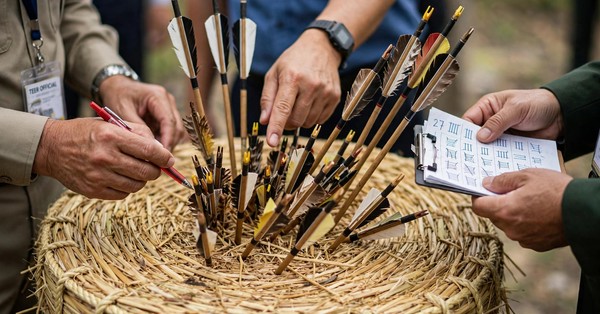
Officials begin by identifying every arrow that is actually stuck in the straw target. Arrows that missed and fell on the ground do not count. Arrows that glanced off do not count. Only arrows firmly lodged in the target are pulled out and tallied. In the first round, with fifty archers shooting up to thirty arrows each, the theoretical maximum is fifteen hundred arrows, and the real number stuck is usually in the hundreds. Pulling and stacking them takes a team of trained hands and a few careful minutes.
How the total is verified
Counting is done more than once. The officials count the arrows, then count again, because the result of the draw depends on this number and there is no room for error. Representatives of the organizing body observe the process. The final agreed total is recorded in writing. This double-checking is one of the reasons the teer draw has survived for decades as a trusted public game. Nobody’s word alone decides the outcome. The arrows are physical, the counting is witnessed, and the math is simple.
Why the last two digits decide everything
Here is the elegant part of how teer draw works. The result is simply the last two digits of the total number of arrows counted. If the officials count, as an example only and not a real result, 742 arrows stuck in the target, the declared result for that round is 42. If they count 613, the result is 13. A total under one hundred just becomes itself. This rule is what turns an archery contest into a lottery, and it is also what makes the game fair in a very specific way. No archer can deliberately produce a particular two-digit number, because nobody can control exactly how many of fifteen hundred arrows stick. The result emerges from the crowd of arrows, not from any single shot.
How Teer Draw Works Across Two Rounds
Every daily teer session has two rounds, and understanding the rhythm of the two rounds is key to understanding the whole game.
First round
The first round is the big one. Fifty archers, up to thirty arrows each, at the larger target. Ticket sales for this round close shortly before shooting begins, usually in the early afternoon for the main Shillong session. After the shooting and counting, the first round result is declared. Ticket holders who picked the winning number for this round earn a payout of eighty rupees for every rupee staked, which is the highest payout of the two rounds.
The pause between rounds
Between the two rounds there is a break. The ground crew resets the target, and in some sessions a smaller target is used for the second round. Ticket counters reopen briefly for second-round sales, giving players a fresh chance to pick numbers. This intermission is also when the ground fills again, because some people come only for the second round.
Second round
The second round follows the same pattern but with fewer arrows. The same fifty archers shoot up to twenty arrows each. The target is typically a bit smaller. Counting and declaration follow the same witnessed procedure. The payout for the second round is sixty rupees for every rupee staked. Players who correctly pick the numbers of both rounds achieve what is called a forecast, which pays four thousand rupees for every rupee staked. That is why the forecast is the most celebrated outcome in teer, even though it is rare.
The People Who Make the Draw Happen
A teer draw looks effortless from the outside, but it runs on a small army of people with defined roles.
The archers
The archers are the heart of the game. They belong to the local archery clubs, and for many of them the daily draw is steady work. Shooting fifty arrows in two minutes, twice a day, demands stamina and technique. Their skill is genuine. Watch them for a few minutes and you will see that hitting a straw target at fifty to sixty yards with a traditional bow is an athletic achievement, not a gimmick.
The counters and officials
The officials who run the counting are appointed by the organizing association. They manage the timing of the shooting, supervise the counting, verify the totals, and declare the results. Their presence is what separates the teer draw from an informal bet between friends. The Meghalaya Amusements and Betting Tax (Amendment) Act of 1982 is the law that legalized and regulates this game, and the officials are the link between the law and the ground. Teer is a legal lottery in Meghalaya, restricted to players aged eighteen and above, and it should always be played responsibly.
The clubs
The twelve archery clubs of the Khasi Hills Archery Sports Association are the institutional backbone of the Shillong teer. Each club maintains its own archers, its own training, and its own identity. The rotation system, where different clubs supply archers on different days, keeps the draw fresh and spreads the work and the income across the archery community. Other centers have their own bodies. The Jowai game is run by its local association, and the Khanapara game by its own organizers, each following the same basic draw format with local variations in timing and venue.
Where the Draws Take Place
The venue matters, because teer is a ground game and the atmosphere of the ground is part of the experience.
Polo Ground, Shillong
The most famous teer ground in the world is the Polo Ground in Shillong. This is where the main Shillong teer draw happens, and it has hosted archery for longer than the legal lottery has existed. On draw days the ground fills with a mix of regulars, curious visitors, and ticket sellers. If you ever visit Shillong and want to understand how teer draw works in its purest form, the Polo Ground in the afternoon is where to go. Check the Shillong Teer Result page for daily updates from this historic venue.
Khanapara and Jowai grounds
Teer is not only Shillong. The Khanapara teer draw takes place at the Khanapara ground near Guwahati, on the Assam-Meghalaya border, and it has a huge following of its own. The Jowai (also spelled Juwai) teer is shot at its ground in the Jaintia Hills. Each venue runs its own sessions, and results are declared separately for each center. You can follow all of them from the All Teer Results homepage, which brings every center together in one place.
From the Ground to Your Screen – How Results Travel
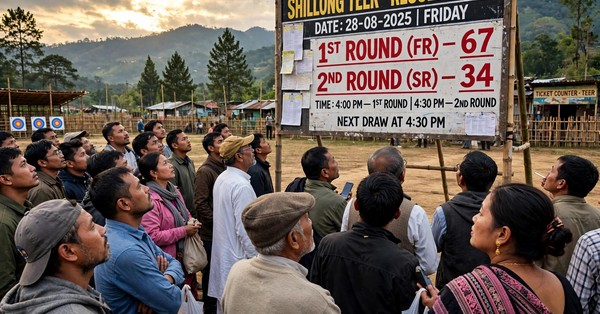
Once the counting is finished and the result is declared at the ground, the number begins a second journey. The organizers release the result officially, and from there it spreads through several channels. Result boards at the ground show the number immediately. Ticket counters announce it to the crowds gathered around them. Local newspapers and evening bulletins carry it. And result websites like ours publish it online so that players who could not be at the ground can check it from their phones.
This website maintains a complete teer result list with the daily numbers from every center, updated as soon as each round is declared. The speed of this chain is part of the modern teer experience. Within minutes of the last arrow being counted, the number can be on a phone screen hundreds of kilometers away. But the chain starts with the physical counting at the ground, and that part cannot be rushed.
Tickets – Your Entry to the Game
No guide to how teer draw works is complete without explaining the ticket, because the ticket is how ordinary people take part in the draw.
Buying a ticket
Tickets are sold at authorized counters across Meghalaya. In Shillong, sales for the day session open around 10 in the morning and close shortly before each round. The buyer picks one or more two-digit numbers from 00 to 99 and pays per number. The minimum stake is one rupee, which is why teer remains a game of the common person rather than the wealthy.
What a ticket carries
A teer ticket is a simple printed slip. It shows the date, the round, the numbers chosen, and the amount staked. Keep it safe, because it is the only proof of your bet. Winners claim their prizes by producing the ticket at the counter. The payout structure is fixed and public. Eighty to one in the first round, sixty to one in the second round, and four thousand to one for a forecast of both rounds. These ratios have been stable for years and are part of what players trust about the game.
Play It Right – Legal and Responsible
Teer occupies a special place because it is a legal, regulated lottery, not an underground game. The Meghalaya Amusements and Betting Tax (Amendment) Act of 1982 brought archery betting under the law, and the game is supervised by recognized associations. That said, it is still a form of betting. Only adults aged eighteen and above may participate, and the golden rule is to play responsibly. Never stake money you cannot afford to lose, treat teer as entertainment rather than income, and take a break if the game stops being fun. Learn more about who we are on our About Us page.
For background on the sport at the heart of teer, see the archery article on Wikipedia, and for the state that hosts this unique game, visit the Government of Meghalaya portal.
Frequently Asked Questions
How does the teer draw actually produce a number?
Fifty archers shoot arrows at a straw target during a timed round. Officials count the arrows stuck in the target in the open, verify the count, and take the last two digits of the total as the round result. As an example only and not a real result, if 738 arrows are counted, the result is 38.
How many rounds happen in a day?
Each daily session has two rounds, called the first round and the second round. The first round uses up to thirty arrows per archer, and the second round uses up to twenty. Results are declared separately for each round.
Who organizes the teer draw in Shillong?
The Shillong teer is organized by the Khasi Hills Archery Sports Association, which is made up of twelve archery clubs. The archers come from these clubs on a rotating schedule.
Where is the main teer ground?
The main Shillong teer draw is held at the Polo Ground in Shillong. Other centers have their own grounds, such as the Khanapara ground near Guwahati and the Jowai ground in the Jaintia Hills.
Is teer legal?
Yes. Teer is a legal lottery in the state of Meghalaya, governed by the Meghalaya Amusements and Betting Tax (Amendment) Act of 1982. It is restricted to players aged eighteen and above, and it should be played responsibly.
How long does one round of shooting take?
Each round of shooting is completed within about two minutes. The archers loose their arrows in rapid succession, and shooting stops on the official signal.
What happens between the first and second round?
There is a break during which the target is reset and ticket counters reopen briefly for second-round sales. Then the second round of shooting and counting takes place, following the same procedure.
The Draw Never Lies
There is something deeply satisfying about a lottery whose result you can watch being made. No spinning drum behind glass, no computer generating digits in a back room. Just fifty archers, a straw target, and a crowd of witnesses watching every arrow land and every arrow counted. That is how teer draw works, and that is why it has kept the trust of millions of players for decades. From the first arrow of the afternoon to the last two digits on the result board, the teer draw process is open, physical, and honest. Check the latest numbers on the All Teer Results homepage, and remember to play responsibly.