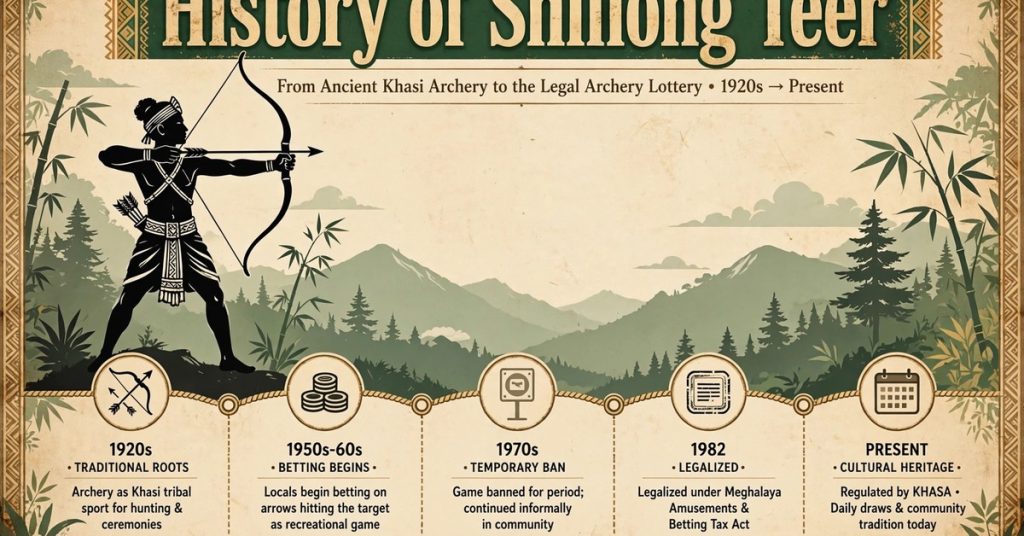
# History of Shillong Teer – From Tradition to Lottery
The history of Shillong Teer is really the remarkable story of how an everyday tribal skill turned into one of India’s most unusual legal lotteries. Long before it had fixed rounds, licensed counters, or printed tickets, teer was simply archery. Men in the Khasi Hills shot arrows at targets for sport, for practice, and for pride. Somewhere along the way, spectators began wagering on the outcome, and that quiet habit grew into a daily ritual that now shapes the rhythm of an entire city, from morning ticket queues to evening result boards. If you have ever wondered how a bow and arrow became a lottery ticket, this timeline walks you through every major chapter.

The History of Shillong Teer Begins Long Before the Lottery
To understand the shillong teer origin, you have to start with the Khasi people and their hills. The Khasis are the indigenous tribal community of the Khasi Hills in what is now Meghalaya, and archery has sat at the center of their culture for as long as anyone can remember. The bow was a hunting tool, a weapon for defense, and a marker of manhood passed from father to son. Village contests tested who could shoot straight, and festivals often included archery as a showpiece event. Nobody was betting on it yet. It was simply what people did.
Locals have their own name for the archery game. Many old-timers call it “Thoh Tim,” a phrase from the Khasi language that refers to the traditional archery contest. The Hindi word “teer,” meaning arrow, came later and stuck because it traveled well across languages. Both names point to the same thing: men, bows, and a target. When researchers write about traditional archery teer today, they usually trace it to these village contests, where skill with a bow earned respect long before it earned money. You can read more about the community behind the game on the Khasi people page at Wikipedia.
What matters for the teer historical background is that archery was never a fringe hobby here. It was woven into daily life. Boys learned to string a bow the way children elsewhere learn to kick a ball. Elders passed down techniques for judging wind and distance. The cylindrical hay target that teer uses today is a direct descendant of those old village targets. So when people ask where Shillong Teer came from, the honest answer is that it did not come from anywhere. It grew out of the soil of the Khasi Hills.
When Teer Started in Meghalaya: The 1950s Betting Record
The question of when teer started in Meghalaya has a surprisingly precise answer, at least for the betting side of it. According to reporting by Firstpost, the first recorded instance of people wagering on archery contests in Shillong dates back to 1952-53. That is the earliest paper trail. Before that, any betting would have been informal and unrecorded, the kind of side wager friends make without writing anything down.
The game did not yet look like the teer you know today. In the early 1950s, the contests were still traditional archery meets, and the betting was unstructured. There were no fixed rounds, no published results, no counters. But the seed was planted. Crowds were already gathering to watch, and where crowds gather, stakes follow.
The real breakthrough came in the late 1950s. As journalist Teresa Rehman documented in Open Magazine, archery contests in Shillong “took their present form” around that time, when organizers adapted the results to the needs of gambling. The key innovation was beautifully simple: count the arrows embedded in the target, and let the last two digits of that count be the winning number. If 1,043 arrows hit the target, the winning number was 43 (example only, not a real result). That single rule turned a subjective contest of skill into an objective, verifiable number game. It is the same core mechanic teer uses today, and it was born in Shillong in the late 1950s.
Think about what that change meant. Before it, betting on archery was messy. Who won? By how much? Arguments were inevitable. After it, everything reduced to a count that officials could verify in front of witnesses. The number could not be argued with. That transparency is a big part of why the game kept growing, and it marks the true beginning of teer game history as a lottery rather than a sport.
The 1960s: Popularity, Crackdowns, and the Underground Years
By the late 1960s, archery betting in Shillong had exploded in popularity, and that popularity brought trouble. Meghalaya did not exist yet as a state. The Khasi Hills were part of Assam, and the Assam government took a dim view of gambling. As Firstpost reported, quoting Khasi Hills Archery Sports Institute president Philip G Khongsngi, the late 1960s were when “archery got really popular in Shillong, and the government of Assam wanted to ban it.” Police were given authority to arrest the bookies who took bets.
Picture the scene. Archery competitions were held openly at various grounds around Shillong. The shooting itself was legal and traditional. But the betting that surrounded it was underground, run by bookies who risked arrest every single day. The khasi archery history of this era is really two histories at once: a proud public tradition of the bow, and a shadow economy of wagers that the authorities kept trying to stamp out.
This tension defined teer for more than a decade. The game could not be killed because it was too deeply rooted. You cannot arrest an entire culture’s favorite pastime. But it could not be regulated either, because no law recognized it. Bookies operated in a gray zone, players had no protection, and disputes were settled the way disputes get settled when no court will hear your case. It was, by every account, a chaotic period, and it set the stage for the most important political fight in the game’s history.

1972: Statehood Changes Everything
In 1972, Meghalaya became a separate Indian state, carved out of Assam. That political change reshaped the teer historical background completely. The new state had its own government, its own assembly, and crucially, its own attitude toward the archery game. Where Assam had seen a gambling problem to be crushed, Meghalaya’s leaders saw a cultural institution that could be brought into the light.
The Khasi Hills Archery Sports Institute, known as KHASI, became the game’s organized voice. The institute had grown out of an earlier body called the Archery Board Control, and it represented the archery clubs of Shillong. After statehood, KHASI began negotiating with the Meghalaya government to legalize betting on teer. The argument was straightforward. The game was happening anyway. Legalizing it would let the state regulate it, tax it, and protect players, while keeping a beloved tradition alive.
Those negotiations took a full decade. Ten years of proposals, debates, and political maneuvering. It is easy to forget how bold the idea was. No other Indian state had legalized anything like this. Teer was, and remains, a one-of-a-kind arrangement: a lottery decided by real arrows shot by real archers, run under state law. The officials who pushed for it were betting their reputations on the idea that tradition and regulation could coexist. The Government of Meghalaya portal carries the state’s official records of the laws that eventually made it happen.
October 1, 1982: The Day Teer Became Legal
The patience paid off. On October 1, 1982, the proposal to legalize teer betting was approved, and the game came under the Meghalaya Amusement and Betting Tax (Amendment) Act of 1982. That date is the single most important milestone in the entire history of Shillong Teer. Everything before it was prelude. Everything after it is the modern game.
Legalization changed the mechanics of daily life around teer almost overnight. Bookies could no longer be arrested for doing their job, provided they bought a license from the government. Betting counters could operate openly on the streets of Shillong instead of hiding. The state began collecting tax revenue from the game. Rules were written down: who could shoot, how many arrows, how targets were measured, how results were counted and announced.
The transformation was not just legal. It was psychological. A game that had lived in the shadows for thirty years could now be played in daylight. Fathers who had hidden their betting slips could buy tickets openly. The archers, once caught between tradition and the law, became the licensed heart of a state-recognized sport. If you want to see how far the game has come, compare the nervous underground of the 1960s with the orderly ticket queues of today. The teer result list on our site shows the modern face of that system: daily, transparent, and open to everyone.
The History of Shillong Teer After 1982: The Modern Game
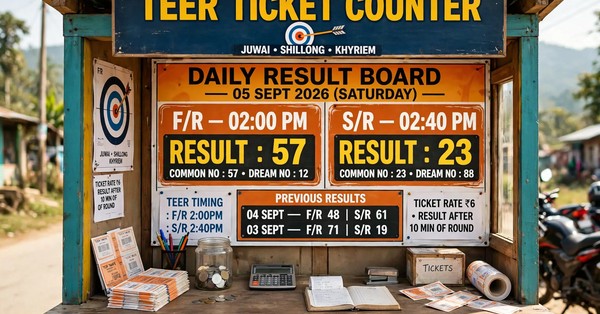
Once teer was legal, the details got standardized, and the game settled into the form millions recognize today. Two rounds are shot each playing day. In the first round, each archer shoots 30 arrows at the target. In the second round, each shoots 20. Officials count every arrow that sticks in the hay target, and the last two digits of the total become the winning number for that round. To show the format clearly, here is an illustration only: if officials counted 567 hitting arrows, the declared number would be 67. That is an example only, not a real result. Real results are never invented here.
The physical setup was standardized too. The target is a cylindrical bundle of hay, between 61 and 102 centimeters tall, with a circumference between 66 and 127 centimeters. Archers shoot from a distance of roughly 15 to 30 meters. The Polo Ground in Shillong remains the spiritual home of the game, the ground where the daily competition unfolds in front of crowds, while traditional archery without any betting continues there on Sundays and during festivals.
The economics grew with the legality. Licensed counters multiplied across Shillong and the rest of Meghalaya. By 2008-09, the state had issued licenses to 1,537 teer counters, earning about Rs 115.5 lakh in revenue, while the total annual turnover of bets was estimated at up to Rs 750 crore when out-of-state play was factored in. A ticket costs as little as Re 1, and a winning Re 1 bet pays Rs 80 in the first round and Rs 60 in the second. Guessing both rounds correctly, called a forecast, pays Rs 4,000 for every Re 1. Those payout ratios have barely changed since the 1980s, which tells you how stable the system became once the law embraced it.
Today the game runs six days a week, Monday through Saturday, with Sundays reserved as a holiday. The Khasi Hills Archery Sports Institute still governs the sport, and its affiliated clubs take turns shooting under a published roster. What began as village boys testing their aim has become a regulated institution that employs archers, sustains thousands of counter operators, funds state revenue, and entertains lakhs of followers. You can follow the daily continuation of this long story on our homepage, where fresh results are posted every playing day, or open the Shillong teer result page for the flagship market. If you want to know more about the site itself, our about us page explains what we do.
How Results Traveled Before the Internet
It is worth pausing on how people actually learned the winning number in the decades before smartphones. In the 1960s and 1970s, there were no websites and no live streams. The count happened at the ground, in front of witnesses, and the number spread the old-fashioned way. Counter operators wrote it on blackboards outside their shops. Runners carried it through the bazaars. By evening, the whole of Shillong knew. That word-of-mouth network was remarkably fast, and it explains why teer never needed advertising. The result itself was the product, and the city was the distribution system.
When printed result slips and later SMS services arrived, they simply formalized what the bazaar had always done. The daily rhythm stayed the same: tickets in the morning, shooting in the afternoon, the number by evening. Even now, with instant updates online, many older players still walk past their regular counter to see the board, out of habit as much as anything. The technology changed, but the ritual did not.
Frequently Asked Questions
When did Shillong Teer start?
The archery tradition behind it is centuries old among the Khasi people, but the first recorded betting on archery contests dates to 1952-53. The game’s present number-based format emerged in the late 1950s, and it became a legal lottery on October 1, 1982.
When was Shillong Teer legalized?
Betting on teer was legalized in Meghalaya on October 1, 1982, under the Meghalaya Amusement and Betting Tax (Amendment) Act of 1982. Before that date, the betting side of the game was illegal and bookies could be arrested.
What does the word “teer” mean?
Teer is the Hindi word for arrow. The Khasi name for the traditional archery contest is “Thoh Tim,” and some locals also call the game “Siat Khnam.” All of these names describe the same archery-based game played at Shillong’s Polo Ground.
Who organizes Shillong Teer?
The Khasi Hills Archery Sports Institute (KHASI) governs the sport. It grew out of the earlier Archery Board Control and represents the affiliated archery clubs of Shillong, issuing shooting rosters and overseeing the daily competition at the Polo Ground.
Why is teer legal in Meghalaya but not in neighboring states?
Meghalaya passed its own law, the Meghalaya Amusement and Betting Tax (Amendment) Act of 1982, specifically bringing teer betting under state regulation and taxation. Neighboring states like Assam never passed an equivalent law, so betting on the game remains illegal there.
Where is Shillong Teer played?
The main daily competition takes place at the Polo Ground in Shillong, Meghalaya. Traditional archery contests without betting are also held there on Sundays and during festivals, keeping the non-commercial side of the tradition alive for the next generation.
A Tradition That Learned to Live With the Law
The history of Shillong Teer ends up being a story about balance. The Khasi people kept their archery alive through centuries of change. Spectators turned it into a numbers game in the 1950s. The state tried to crush the betting in the 1960s, then chose to regulate it in the 1980s. Each era added a layer, and the game you see today carries all of them: the village bow, the 1950s wager, the 1982 law, and the daily ritual at Polo Ground. Few lotteries anywhere in the world can claim a lineage like that, decided by real arrows in flight rather than balls in a machine. Teer is a legal lottery in Meghalaya for adults aged 18 and above, so if you follow it, do so responsibly and treat it as entertainment, never as income.